Karyotyping
Karyotyping is a laboratory technique used to analyze the number, size, and shape of chromosomes in an individual's cells. It is often used to detect chromosomal abnormalities, such as aneuploidy or structural rearrangements.
Steps Involved in Karyotyping:
- Cell Collection: Cells are collected from the individual, typically from a blood sample or amniotic fluid.
- Cell Culture: The collected cells are cultured in a laboratory to stimulate cell division and chromosome replication.
- Chromosome Harvesting: Cells are treated to stop cell division at a stage where chromosomes are condensed and visible.
- Chromosome Staining: Staining techniques are used to visualize the banding patterns on the chromosomes, which helps in identifying individual chromosomes.
- Microscopy and Analysis: Chromosomes are observed under a microscope, and an image of the karyotype is created. The chromosomes are arranged and analyzed based on their size, centromere position, and banding patterns.
Applications of Karyotyping:
- Detection of chromosomal disorders such as Down syndrome, Klinefelter syndrome, Turner syndrome, and others.
- Identification of structural chromosomal abnormalities, such as translocations, deletions, and duplications.
- Assessment of cancer cells to identify chromosomal abnormalities associated with specific types of cancer.
- Forensic analysis to determine genetic relationships and identify individuals.
Study Tips for Karyotyping:
- Understand the structure and function of chromosomes, including the role of centromeres and telomeres.
- Learn about different types of chromosomal abnormalities and their effects on an individual's health.
- Practice interpreting karyotype images and identifying normal and abnormal chromosome patterns.
- Review the ethical considerations and implications of karyotyping, especially in prenatal testing and genetic counseling.
[Karyotyping] Related Worksheets and Study Guides:
.◂Biology Worksheets and Study Guides High School. Microorganisms I
Worksheet/Answer key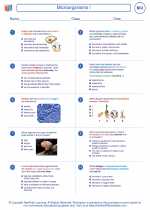 Microorganisms I
  Worksheet/Answer key
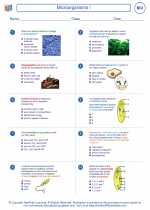 Microorganisms I Worksheet/Answer key
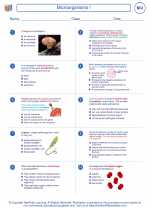 Microorganisms I Worksheet/Answer key
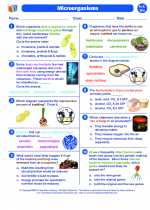 Microorganisms I Vocabulary/Answer key
 Microorganisms I Vocabulary/Answer key
 Microorganisms I Vocabulary/Answer key
 Microorganisms I Vocabulary/Answer key
 Microorganisms I Vocabulary/Answer key
 Microorganisms I
Worksheet/Answer keyWorksheet/Answer keyWorksheet/Answer keyVocabulary/Answer keyVocabulary/Answer keyVocabulary/Answer keyVocabulary/Answer keyVocabulary/Answer keyThe resources above cover the following skills:
BIOLOGY
Unity and Diversity
Obtain, evaluate, and communicate information to explain how organisms are classified by physical characteristics, organized into levels of taxonomy, and identified by binomial nomenclature (e.g., taxonomic classification, dichotomous keys).
Engage in argument to justify the grouping of viruses in a category separate from living things.