Gymnosperms
Gymnosperms are a group of seed-producing plants that includes conifers, cycads, Ginkgo, and gnetophytes. They are characterized by the presence of naked seeds, which are not enclosed within an ovary or fruit.
Characteristics of Gymnosperms:
- Seeds: Gymnosperms produce seeds that are not enclosed within a fruit. The seeds are typically found on the surface of cone scales.
- Cones: Most gymnosperms reproduce using cones. Male cones produce pollen, while female cones contain ovules that develop into seeds.
- Needle-like or scale-like leaves: Gymnosperms often have needle-like or scale-like leaves, which help reduce water loss and protect them from harsh environmental conditions.
- Woody stems: Gymnosperms have woody stems that provide structural support to the plant.
Examples of Gymnosperms:
Some common examples of gymnosperms include:
- Conifers: This group includes pines, spruces, firs, and cedars.
- Cycads: Cycads are palm-like plants with large compound leaves and stout trunks.
- Ginkgo: Ginkgo biloba is a unique gymnosperm with fan-shaped leaves.
- Gnetophytes: This group includes three genera: Gnetum, Welwitschia, and Ephedra.
Importance of Gymnosperms:
Gymnosperms play a crucial role in the ecosystem and have economic importance as well. They are a source of timber, paper, resins, and medicinal products. Additionally, they contribute to the global carbon cycle and provide habitats for various organisms.
Study Guide:
When studying gymnosperms, it's important to focus on the following key points:
- Understanding the unique reproductive structures of gymnosperms, such as cones and naked seeds.
- Recognizing the different groups of gymnosperms and their distinguishing characteristics.
- Exploring the ecological and economic significance of gymnosperms.
- Comparing the life cycles of gymnosperms with those of other plant groups, such as angiosperms.
- Identifying specific examples of gymnosperms and their adaptations to various environments.
By mastering these concepts, you can develop a comprehensive understanding of gymnosperms and their importance in the natural world.
.◂Biology Worksheets and Study Guides High School. Microorganisms II
Worksheet/Answer key Microorganisms II
  Worksheet/Answer key
 Microorganisms II Worksheet/Answer key
 Microorganisms II Vocabulary/Answer key
 Microorganisms II Vocabulary/Answer key
 Microorganisms II Vocabulary/Answer key
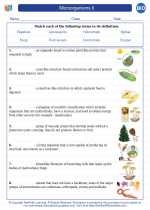 Microorganisms II Vocabulary/Answer key
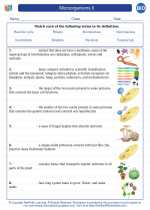 Microorganisms II Vocabulary/Answer key
 Microorganisms II
Worksheet/Answer keyWorksheet/Answer keyVocabulary/Answer keyVocabulary/Answer keyVocabulary/Answer keyVocabulary/Answer keyVocabulary/Answer keyThe resources above cover the following skills:
Life Science
Organization and Development of Living Organisms - A. Cells have characteristic structures and functions that make them distinctive. B. Processes in a cell can be classified broadly as growth, maintenance, reproduction, and homeostasis. C. Life can be organized in a functional and structural hierarchy ranging from cells to the biosphere. D. Most multicellular organisms are composed of organ systems whose structures reflect their particular function.
Relate the major structure of fungi to their functions.
Diversity and Evolution of Living Organisms - A. The scientific theory of evolution is the fundamental concept underlying all of biology. B. The scientific theory of evolution is supported by multiple forms of scientific evidence. C. Organisms are classified based on their evolutionary history. D. Natural selection is a primary mechanism leading to evolutionary change.
Discuss distinguishing characteristics of the domains and kingdoms of living organisms.