Radioactive Decay
Radioactive decay is the process by which an unstable atomic nucleus loses energy by emitting radiation, such as alpha or beta particles, or gamma rays. This process results in the transformation of the original atom into a different element or isotope. The rate of decay is typically measured by the half-life of the radioactive substance, which is the time it takes for half of the atoms in a sample to decay.
Types of Radioactive Decay
There are several types of radioactive decay, including:
- Alpha Decay: In alpha decay, an atom emits an alpha particle, which consists of two protons and two neutrons. This results in the atom's atomic number decreasing by 2 and its mass number decreasing by 4.
- Beta Decay: Beta decay involves the emission of beta particles, which can be either electrons or positrons. In beta-minus decay, a neutron is transformed into a proton, while in beta-plus decay, a proton is transformed into a neutron.
- Gamma Decay: Gamma decay occurs when an excited nucleus releases gamma rays, resulting in no change to the atomic or mass numbers of the atom.
Study Guide
To understand radioactive decay, consider the following key points:
- Define radioactive decay and explain its significance in the context of nuclear stability.
- Identify the types of radiation emitted during radioactive decay and explain their properties.
- Understand the concept of half-life and how it is used to measure the rate of decay of a radioactive substance.
- Describe the processes involved in alpha, beta, and gamma decay, including the resulting changes to atomic and mass numbers.
- Discuss the practical applications of radioactive decay, such as carbon dating and medical imaging.
By mastering the principles of radioactive decay, you will develop a strong foundation in nuclear chemistry and its real-world implications.
[Radioactive Decay] Related Worksheets and Study Guides:
.◂Chemistry Worksheets and Study Guides High School. Elements - Set I
Worksheet/Answer key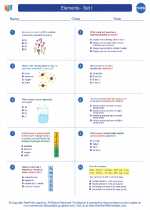 Elements - Set I
  Worksheet/Answer key
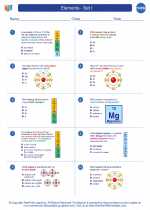 Elements - Set I Worksheet/Answer key
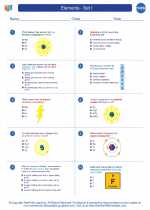 Elements - Set I
Worksheet/Answer keyWorksheet/Answer keyThe resources above cover the following skills:
PHYSICAL SCIENCE (NGSS)
Matter and Its Interactions
Students who demonstrate understanding can:
Use the periodic table as a model to predict the relative properties of elements based on the patterns of electrons in the outermost energy level of atoms.
Plan and conduct an investigation to gather evidence to compare the structure of substances at the bulk scale to infer the strength of electrical forces between particles.