Fusion Reaction
Fusion reaction is a type of nuclear reaction in which two light atomic nuclei combine to form a heavier nucleus. This process releases a large amount of energy and is the fundamental process that powers the sun and other stars. Fusion reactions are different from fission reactions, which involve the splitting of heavy atomic nuclei.
Key Concepts
- Nuclear Fusion: Fusion is the process in which two light atomic nuclei combine to form a heavier nucleus, releasing a large amount of energy in the process.
- Fusion Reactants: The reactants in a fusion reaction are typically light atomic nuclei, such as isotopes of hydrogen.
- Energy Release: Fusion reactions release a significant amount of energy, which is the basis for the potential use of fusion as a clean and abundant source of power.
- Stellar Fusion: Fusion reactions power the sun and other stars, providing the energy that sustains their luminosity and heat.
- Fusion on Earth: Scientists are working on developing controlled fusion reactions for energy production on Earth, but significant technical challenges remain.
Study Guide
To understand fusion reactions better, it's important to grasp the following key points:
- Learn the basic principles of nuclear fusion and how it differs from nuclear fission.
- Study the different types of fusion reactions, including those involving hydrogen isotopes such as deuterium and tritium.
- Understand the conditions required for fusion to occur, including high temperatures and pressure to overcome the electrostatic repulsion between positively charged nuclei.
- Explore the energy release from fusion reactions and how it can be harnessed for practical applications.
- Examine the challenges and current research efforts in achieving controlled fusion reactions on Earth for power generation.
By mastering these concepts and study areas, you will gain a solid understanding of fusion reactions and their potential implications for energy production and astrophysics.
[Fusion Reaction] Related Worksheets and Study Guides:
.◂Chemistry Worksheets and Study Guides High School. Lab Investigations/Scientific Method
Worksheet/Answer key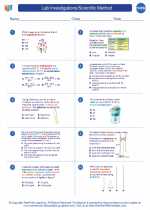 Lab Investigations/Scientific Method
  Worksheet/Answer key
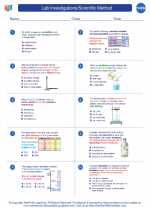 Lab Investigations/Scientific Method Worksheet/Answer key
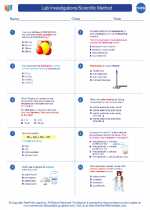 Lab Investigations/Scientific Method
Worksheet/Answer keyWorksheet/Answer keyThe resources above cover the following skills:
Earth and Space Science (ES)
Earth Processes
Explain how Earth's fluid outer core creates the magnetosphere and how this helps protect both humans and technology (such as satellites) from solar winds.