Quasars
A quasar is a compact, extremely bright object located at the center of a galaxy. Quasars are powered by supermassive black holes that are actively accreting matter. They emit enormous amounts of energy across the electromagnetic spectrum, making them visible from great distances.
Key Concepts
- Supermassive Black Holes: Quasars are associated with supermassive black holes at the centers of galaxies. These black holes have masses ranging from millions to billions of times that of the Sun.
- Energy Emission: Quasars emit energy across the electromagnetic spectrum, including radio waves, infrared, visible light, ultraviolet, X-rays, and gamma rays.
- Redshift: Due to the expansion of the universe, light from quasars is often redshifted, which provides information about their distance and the age of the universe.
- Evolution: Quasars are more common in the early universe and are thought to be associated with the growth of galaxies and the formation of large-scale structures.
Study Guide
When studying quasars, it's important to focus on the following aspects:
- Black Hole Accretion: Understand the process of accretion onto supermassive black holes and how it powers the quasar's luminosity.
- Emission Spectrum: Learn about the different wavelengths of energy emitted by quasars and the information they provide about the physical conditions in the vicinity of the black hole.
- Observational Techniques: Explore the methods used to detect and study quasars, including spectroscopy, multiwavelength observations, and surveys.
- Cosmological Significance: Consider the implications of quasar observations for our understanding of the early universe, galaxy formation, and the large-scale structure of the cosmos.
By mastering these concepts and study areas, you'll gain a deeper understanding of the fascinating and enigmatic nature of quasars.
.◂Chemistry Worksheets and Study Guides High School. Mixtures and Compounds
Worksheet/Answer key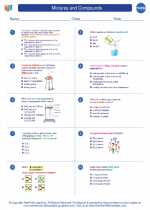 Mixtures and Compounds
  Worksheet/Answer key
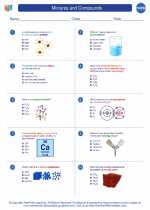 Mixtures and Compounds Worksheet/Answer key
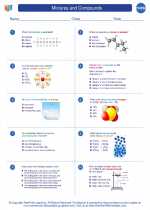 Mixtures and Compounds
Worksheet/Answer keyWorksheet/Answer keyThe resources above cover the following skills:
Chemistry II
Properties of Matter
Develop and use models to explain the differences between chemical compounds using patterns as a method for identification.
Use mathematical representations to quantify matter through the analysis of patterns in chemical compounds.