Month
A month is a unit of time, used with calendars, which is approximately as long as a natural period related to the motion of the Moon; month and Moon are cognates.
Types of Months
There are different types of months:
- Synodic Month: The time between two similar phases of the Moon (e.g., new moon to new moon).
- Sidereal Month: The time it takes the Moon to complete one orbit around the Earth with respect to the fixed stars.
- Tropical Month: The time for the Moon to return to the same celestial longitude as the Sun, which is about 27.32 days.
Calendars and Months
Most modern calendars have 12 months in a year. The number of days in each month can vary. For example, the Gregorian calendar, which is widely used today, has the following number of days in each month:
| Month | Number of Days |
|---|---|
| January | 31 |
| February | 28 or 29 (in leap years) |
| March | 31 |
| April | 30 |
| May | 31 |
| June | 30 |
| July | 31 |
| August | 31 |
| September | 30 |
| October | 31 |
| November | 30 |
| December | 31 |
Study Guide
To understand the concept of months, consider the following questions:
- What are the different types of months?
- How do different calendars organize their months?
- Why does February have 28 days in common years and 29 days in leap years?
- What is the significance of the phases of the Moon in determining a month?
- How are months related to the motion of the Moon?
By exploring these questions, you can gain a deeper understanding of the concept of months and their role in timekeeping and celestial motion.
.◂Earth Science Worksheets and Study Guides High School. The Atmosphere
Worksheet/Answer key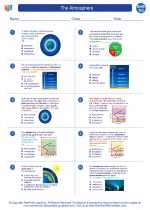 The Atmosphere
  Worksheet/Answer key
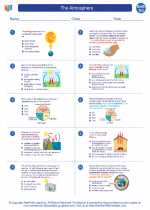 The Atmosphere Worksheet/Answer key
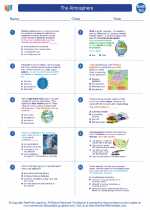 The Atmosphere Vocabulary/Answer key
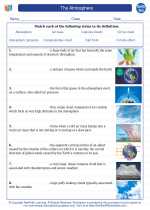 The Atmosphere Vocabulary/Answer key
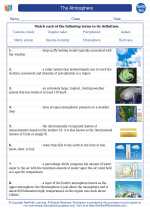 The Atmosphere Vocabulary/Answer key
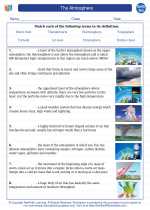 The Atmosphere
Worksheet/Answer keyWorksheet/Answer keyVocabulary/Answer keyVocabulary/Answer keyVocabulary/Answer keyThe resources above cover the following skills:
EARTH AND SPACE SCIENCE (NGSS)
Earth and Human Activity
Students who demonstrate understanding can:
Use a computational representation to illustrate the relationships among Earth systems and how those relationships are being modified due to human activity.
EARTH AND SPACE SCIENCE (NGSS)
Earth and Human Activity
Students who demonstrate understanding can:
Use a computational representation to illustrate the relationships among Earth systems and how those relationships are being modified due to human activity.
EARTH AND SPACE SCIENCE (NGSS)
Earth and Human Activity
Students who demonstrate understanding can:
Use a computational representation to illustrate the relationships among Earth systems and how those relationships are being modified due to human activity.
EARTH AND SPACE SCIENCE (NGSS)
Earth and Human Activity
Students who demonstrate understanding can:
Use a computational representation to illustrate the relationships among Earth systems and how those relationships are being modified due to human activity.