Structure of Guanine
The chemical structure of guanine consists of a fused ring system comprising a pyrimidine ring and an imidazole ring. It has the molecular formula C5H5N5O and a molar mass of 151.13 g/mol. The structure of guanine includes functional groups such as an amine group and carbonyl group.Functions of Guanine
Guanine plays a crucial role in the genetic code as it forms base pairs with cytosine, contributing to the stability and specificity of DNA and RNA. Additionally, guanine is involved in various cellular processes including signaling, energy transfer, and enzyme reactions.Study Guide for Guanine
To understand guanine in depth, consider the following study guide:- Learn about the chemical structure of guanine, including its molecular formula, ring system, and functional groups.
- Understand the role of guanine in DNA and RNA, particularly its base pairing with cytosine and its contribution to genetic information storage and transmission.
- Explore the functions of guanine beyond its role in genetic material, such as its involvement in cellular processes and signaling.
- Study the methods of guanine synthesis and its occurrence in living organisms.
- Examine the significance of guanine in the context of human health and diseases related to genetic mutations involving guanine.
[Guanine] Related Worksheets and Study Guides:
.◂Earth Science Worksheets and Study Guides High School. Weather I
Worksheet/Answer key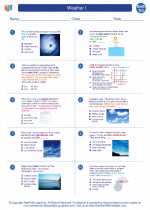 Weather I
  Worksheet/Answer key
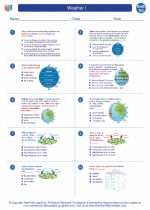 Weather I Worksheet/Answer key
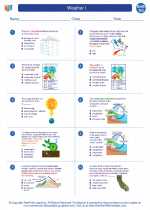 Weather I Worksheet/Answer key
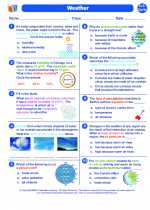 Weather I Vocabulary/Answer key
 Weather I Vocabulary/Answer key
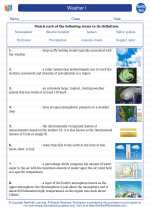 Weather I Vocabulary/Answer key
 Weather I
Worksheet/Answer keyWorksheet/Answer keyWorksheet/Answer keyVocabulary/Answer keyVocabulary/Answer keyVocabulary/Answer keyThe resources above cover the following skills:
ENVIRONMENTAL SCIENCE
Earth and Human Activity
Develop and use models to trace the flow of water, nitrogen, and phosphorus through the hydrosphere, atmosphere, geosphere, and biosphere.