Amperes
Amperes, symbolized by the letter "A", are the unit of measurement for electric current. One ampere is defined as the amount of electric charge that passes through a point in a conductor in one second when there is a constant current of one coulomb per second. In other words, it measures the flow of electric charge through a conducting material.
Electric current is the rate at which electric charge flows past a point in a circuit. It is analogous to the flow of water in a pipe – the greater the current, the more electric charge is flowing through the circuit.
Study Guide
- Definition: Understand the definition of an ampere and its significance in measuring electric current.
- Formula: Familiarize yourself with the formula for calculating current (I = Q/t) where I is the current in amperes, Q is the charge in coulombs, and t is the time in seconds.
- Units: Be able to convert between amperes and other units of electric current, such as milliamperes or microamperes.
- Applications: Explore the various applications of amperes in real-life scenarios, such as household circuits, electronic devices, and industrial machinery.
- Ohm's Law: Understand the relationship between current, voltage, and resistance as described by Ohm's law (I = V/R) where V is the voltage in volts and R is the resistance in ohms.
By mastering the concept of amperes, you will develop a strong foundation in understanding the behavior of electric currents and their role in electrical systems.
.◂Physics Worksheets and Study Guides High School. Atomic and Nuclear Physics
Worksheet/Answer key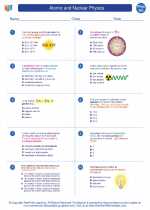 Atomic and Nuclear Physics
  Worksheet/Answer key
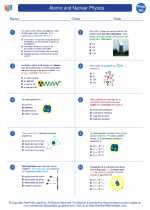 Atomic and Nuclear Physics Worksheet/Answer key
 Atomic and Nuclear Physics Worksheet/Answer key
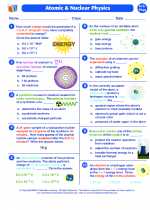 Atomic and Nuclear Physics
Worksheet/Answer keyWorksheet/Answer keyWorksheet/Answer keyThe resources above cover the following skills:
PHYSICAL SCIENCE
Matter and Its Interactions
Develop models to illustrate the concept of half-life for radioactive decay.
Research and communicate information about types of naturally occurring radiation and their properties.