Gamma Rays
Gamma rays are a form of electromagnetic radiation that have the highest energy and shortest wavelength in the electromagnetic spectrum. They are produced by the decay of atomic nuclei and are often associated with processes such as nuclear reactions and radioactive decay.
Properties of Gamma Rays
- High Energy: Gamma rays have energies ranging from hundreds of keV to several MeV, making them the most energetic form of electromagnetic radiation.
- Penetrating Power: Gamma rays can penetrate most materials, including metal and concrete. They require dense materials such as lead or several centimeters of concrete to effectively shield against them.
- No Charge: Gamma rays are neutral and do not carry an electric charge.
- Ionizing Ability: Gamma rays have high ionizing ability, meaning they can ionize atoms and molecules they interact with, causing damage to living tissues.
Production of Gamma Rays
Gamma rays are produced in a variety of natural and artificial processes, including:
- Nuclear reactions, such as those occurring in stars and nuclear power plants
- Radioactive decay of unstable atomic nuclei
- Certain types of particle interactions, such as electron-positron annihilation
Uses and Applications
Gamma rays have a range of practical applications in fields such as medicine, industry, and research, including:
- Medical imaging and cancer treatment using techniques like gamma ray therapy and gamma ray spectroscopy
- Industrial radiography for inspecting welds, pipelines, and other structures
- Research in astronomy, astrophysics, and nuclear physics
Study Guide
To study gamma rays effectively, consider the following key points:
- Understand the electromagnetic spectrum and where gamma rays are located in relation to other forms of radiation.
- Learn about the properties of gamma rays, including their energy, penetrating power, and ionizing ability.
- Explore the production of gamma rays through processes such as nuclear reactions and radioactive decay.
- Investigate the practical applications of gamma rays in various fields and industries.
- Consider the safety precautions and shielding methods used to protect against gamma ray exposure.
Remember to practice solving problems related to the interaction of gamma rays with matter and their applications in different fields.
For additional resources, consult textbooks, online articles, and instructional videos on the topic of gamma rays.
Good luck with your studies!
.◂Physics Worksheets and Study Guides High School. Atomic and Nuclear Physics
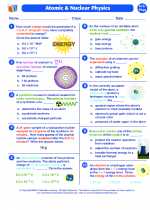
 Worksheet/Answer key
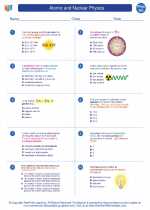
 Worksheet/Answer key
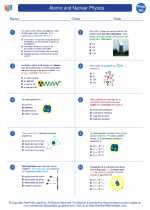
 Worksheet/Answer key