Optics: The Study of Light and its Interactions
Introduction to Optics
Optics is the branch of physics that deals with the behavior and properties of light, including its interactions with matter. It encompasses a wide range of phenomena, including reflection, refraction, diffraction, and interference.
Key Concepts in Optics
There are several key concepts in optics that are important to understand:
- Light: Light is a form of electromagnetic radiation that is visible to the human eye. It exhibits both wave-like and particle-like properties.
- Reflection: Reflection occurs when light bounces off a surface. The angle of incidence is equal to the angle of reflection.
- Refraction: Refraction is the bending of light as it passes from one medium to another. This bending is caused by a change in the speed of light.
- Diffraction: Diffraction is the bending of light around obstacles and the spreading of light when it passes through narrow slits. It demonstrates the wave nature of light.
- Interference: Interference occurs when two or more light waves overlap, leading to the reinforcement or cancellation of the waves.
- Lenses: Lenses are transparent objects that refract light to form images. There are two main types of lenses: convex (converging) lenses and concave (diverging) lenses.
Applications of Optics
Optics has numerous practical applications in fields such as photography, microscopy, astronomy, and telecommunications. Understanding the behavior of light is crucial for the design of optical instruments and devices.
Study Guide for Optics
To study optics effectively, consider the following steps:
- Master the basics: Understand the properties of light, the laws of reflection and refraction, and the behavior of light waves.
- Practice problems: Work through a variety of problems involving reflection, refraction, and the behavior of lenses to reinforce your understanding of the concepts.
- Explore real-world examples: Look for examples of optics in everyday life, such as the functioning of cameras, eyeglasses, and telescopes, to see how the principles of optics are applied.
- Experiment: Conduct simple experiments with mirrors, lenses, and prisms to observe the behavior of light firsthand.
- Review and seek help: Regularly review your notes and seek help from your teacher or tutor if you encounter difficulties in understanding specific concepts.
◂Physics Worksheets and Study Guides High School. Forces - Set II
Worksheet/Answer key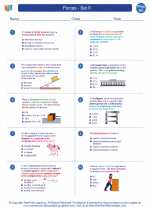 Forces - Set II
  Worksheet/Answer key
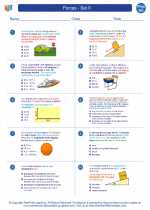 Forces - Set II Worksheet/Answer key
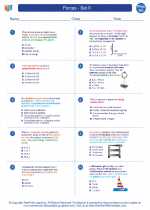 Forces - Set II
Worksheet/Answer keyWorksheet/Answer keyThe resources above cover the following skills:
PHYSICS
Motion and Stability: Forces and Interactions
Identify and analyze forces responsible for changes in rotational motion and develop an understanding of the effect of rotational inertia on the motion of a rotating object (e.g., merry-go-round, spinning toy, spinning figure skater, stellar collapse [supernova], rapidly spinning pulsar).