Understanding Commensalism
- Definition: Commensalism is a relationship between two organisms in which one benefits and the other is neither helped nor harmed.
- Examples: Examples of commensalism include barnacles attaching themselves to whales for transportation, epiphytic plants growing on trees for support, and remoras hitching a ride on sharks to feed off their prey scraps.
- Benefit to one organism: In commensalism, one organism benefits by gaining a resource, such as food, support, or transportation, from the other organism without causing harm to it.
- Neutral effect on the other organism: The organism that is being used in a commensal relationship is not affected positively or negatively. It may be unaware of the presence of the commensal organism.
- Significance: Commensalism is an important aspect of ecological interactions and contributes to the stability and balance of ecosystems.
Study Tips
- Understand the concept: Familiarize yourself with the concept of commensalism and how it differs from other types of ecological relationships, such as mutualism and parasitism.
- Examples: Learn specific examples of commensalism in nature and understand how each organism benefits from the relationship.
- Compare with other relationships: Compare and contrast commensalism with mutualism and parasitism to fully grasp the differences and similarities between these ecological interactions.
- Real-world applications: Explore real-world examples of commensalism in different ecosystems and understand the impact of these relationships on the environment.
- Practice questions: Test your understanding of commensalism with practice questions that require you to identify and explain commensal relationships in various ecological scenarios.
◂Physics Worksheets and Study Guides High School. Laws of Motion - Set I
Worksheet/Answer key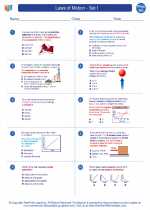 Laws of Motion - Set I
  Worksheet/Answer key
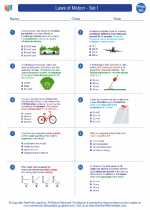 Laws of Motion - Set I Worksheet/Answer key
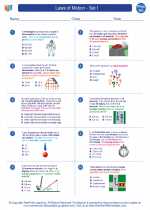 Laws of Motion - Set I Worksheet/Answer key
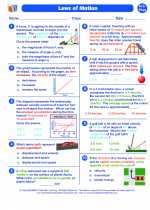 Laws of Motion - Set I
Worksheet/Answer keyWorksheet/Answer keyWorksheet/Answer keyThe resources above cover the following skills:
PHYSICAL SCIENCE (NGSS)
Energy
Students who demonstrate understanding can:
Develop and use models to illustrate that energy at the macroscopic scale can be accounted for as either motions of particles or energy stored in fields.