Third Law of Thermodynamics
The third law of thermodynamics states that as the temperature of a system approaches absolute zero, the entropy of the system approaches a minimum value. This law is also known as the Nernst heat theorem, after the German physicist Walther Nernst who formulated it in 1906.
Key Concepts
- Absolute Zero: The third law of thermodynamics is based on the concept of absolute zero, which is the lowest possible temperature where the thermal motion of particles ceases.
- Entropy: Entropy is a measure of the disorder or randomness of a system. The third law states that as the temperature approaches absolute zero, the entropy of a perfect crystal also approaches zero.
- Unattainability of Absolute Zero: The third law also implies that it is impossible to reach absolute zero in a finite number of steps.
Implications
The third law of thermodynamics has several important implications:
- It provides a basis for the determination of absolute entropies of substances at any temperature.
- It helps in understanding the behavior of matter at extremely low temperatures, such as in the field of cryogenics.
- It sets a limit on the lowest possible temperature that can be achieved in practice.
Applications
The third law of thermodynamics has applications in various fields, including:
- Cryogenics: The study of materials at very low temperatures.
- Quantum Mechanics: Understanding the behavior of particles at extremely low temperatures.
- Magnetic Resonance Imaging (MRI): Utilizing the principles of thermodynamics to produce detailed images of the human body.
Study Guide
To understand the third law of thermodynamics, it is important to grasp the following concepts:
- Understand the concept of entropy and its relation to the disorder of a system.
- Learn about the behavior of substances at low temperatures and the significance of reaching absolute zero.
- Explore the applications of the third law in various scientific and technological fields.
- Review the historical development of the third law and its implications in modern physics.
Mastering the third law of thermodynamics can provide a deeper understanding of the behavior of matter at extreme temperatures and its practical applications in diverse fields.
.◂Physics Worksheets and Study Guides High School. Measurements and Calculations
Worksheet/Answer key Measurements and Calculations
  Worksheet/Answer key
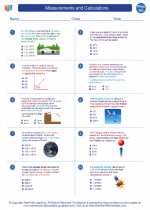 Measurements and Calculations Worksheet/Answer key
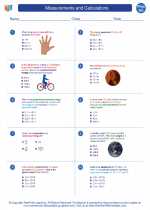 Measurements and Calculations
Worksheet/Answer keyWorksheet/Answer keyThe resources above cover the following skills:
Science Process Skills: Scientific Inquiry and Critical Thinking Skills
Making Observations and Asking Questions: Students will apply skills from previous grades and make measurements and observations about a variety of events and phenomena, including those that occur during very small and very large time frames.