What are Plains?
Plains are large areas of flat or gently rolling land, typically found at low elevations. They are formed by the deposition of sediments over time, often by the action of rivers, glaciers, or wind. Plains can be found on every continent and are an important feature of the Earth's surface.
Types of Plains
There are several different types of plains, including:
- Coastal Plains: These are formed by the deposition of sediments along coastlines, often by the action of waves and currents.
- Interior Plains: These are found far from coastlines and can be formed by a variety of geological processes, including the deposition of sediments by rivers and the movement of glaciers.
- Floodplains: These are low-lying areas adjacent to rivers that are prone to flooding. They are formed by the deposition of sediments carried by the river during floods.
- Glacial Plains: These are formed by the movement of glaciers, which can flatten and sculpt the land as they advance and retreat.
Importance of Plains
Plains are important for several reasons:
- They are often highly fertile and are therefore important for agriculture.
- They are often home to diverse ecosystems, including grasslands and wetlands.
- They are often used for transportation and urban development due to their flat terrain.
Study Guide
Here are some key points to remember about plains:
- What are the main features of plains?
- What are the different types of plains and how are they formed?
- Why are plains important for agriculture?
- How do plains contribute to biodiversity?
- What are some human activities that take place on plains?
Understanding the formation and significance of plains is important for understanding the Earth's surface and the ways in which human activities can impact natural environments.
[Plains] Related Worksheets and Study Guides:
.◂Science Worksheets and Study Guides Third Grade. Did you Know... 3rd grade
Study Guide Did you Know... 3rd grade
  Worksheet/Answer key
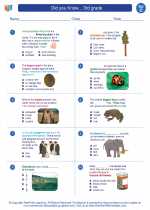 Did you Know... 3rd grade Worksheet/Answer key
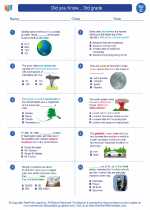 Did you Know... 3rd grade Worksheet/Answer key
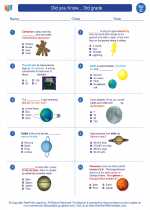 Did you Know... 3rd grade
Worksheet/Answer keyWorksheet/Answer keyWorksheet/Answer keyThe resources above cover the following skills:
LIFE SCIENCE
Unity and Diversity
Construct an argument from evidence to explain the likelihood of an organism’s ability to survive when compared to the resources in a certain habitat (e.g., freshwater organisms survive well, less well, or not at all in saltwater; desert organisms survive well, less well, or not at all in woodlands).
Create models that illustrate how organisms and their habitats make up a system in which the parts depend on each other.