Boyle's Law Equation
The mathematical equation for Boyle's Law is:
center;">\[ P \cdot V = k \]
Where:
Explanation of Boyle's Law
Boyle's Law states that, at constant temperature, the pressure of a given mass of gas is inversely proportional to its volume. In simpler terms, when the volume of a gas decreases, the pressure of the gas increases, and vice versa.
Study Guide for Boyle's Law
- Understanding the Equation: Make sure to understand the equation \( P \cdot V = k \) and how pressure and volume are related.
- Graphical Representation: Practice plotting pressure-volume graphs to visualize the inverse relationship described by Boyle's Law.
- Real-life Examples: Look for examples in everyday life where Boyle's Law is evident, such as inflating a balloon or using a syringe.
- Practical Experiments: Perform experiments to demonstrate Boyle's Law using different gases and varying pressure and volume conditions.
- Problem-Solving: Practice solving numerical problems related to Boyle's Law to reinforce understanding of the concept.
By mastering Boyle's Law, you will gain a deeper understanding of the behavior of gases and their properties. These principles are not only important in the field of science, but also have practical applications in various industries.
.◂Science Worksheets and Study Guides Fourth Grade. Animal Growth and Reproduction
Lesson Plan Animal Growth and Reproduction - Bundle
  Study Guide
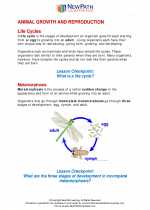 Animal Growth and Reproduction Activity Lesson
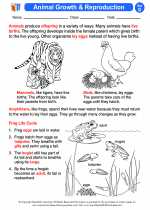 Animal Growth & Reproduction Worksheet/Answer key
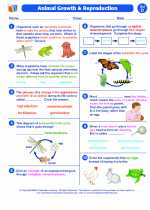
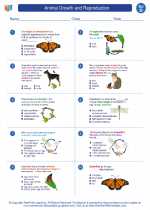 Animal Growth and Reproduction Worksheet/Answer key
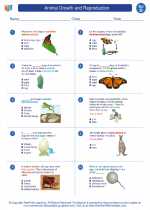 Animal Growth and Reproduction Worksheet/Answer key
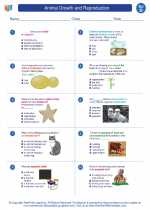 Animal Growth and Reproduction Worksheet/Answer key
 Animal Growth and Reproduction Vocabulary/Answer key
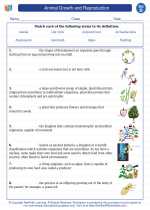 Animal Growth and Reproduction Vocabulary/Answer key
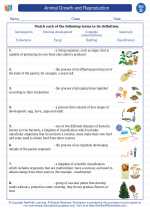 Animal Growth and Reproduction Vocabulary/Answer key
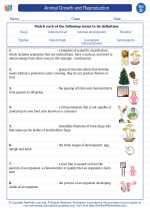 Animal Growth and Reproduction Vocabulary/Answer key
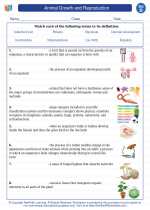 Animal Growth and Reproduction Vocabulary/Answer key
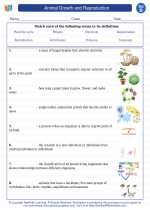 Animal Growth and Reproduction
Study GuideActivity LessonWorksheet/Answer keyWorksheet/Answer keyWorksheet/Answer keyWorksheet/Answer keyVocabulary/Answer keyVocabulary/Answer keyVocabulary/Answer keyVocabulary/Answer keyVocabulary/Answer keyThe resources above cover the following skills:
Life Science
Heredity and Reproduction - A. Offspring of plants and animals are similar to, but not exactly like, their parents or each other. B. Life cycles vary among organisms, but reproduction is a major stage in the life cycle of all organisms.
Compare and contrast the major stages in the life cycles of Florida plants and animals, such as those that undergo incomplete and complete metamorphosis, and flowering and nonflowering seed-bearing plants.