Supermassive Black Holes
A supermassive black hole is a type of black hole with a mass that is millions or even billions of times greater than that of the sun. These black holes are found at the centers of most galaxies, including our own Milky Way. Supermassive black holes are incredibly dense, with gravity so strong that not even light can escape from them. They are formed from the collapse of massive stars or the merging of smaller black holes over time.
Characteristics of Supermassive Black Holes:
- Size: Supermassive black holes have a diameter ranging from millions to billions of kilometers.
- Mass: They have masses equivalent to millions or billions of suns.
- Formation: They are formed through the accumulation of mass over time, often at the centers of galaxies.
- Effects: Supermassive black holes can influence the movement and behavior of stars and other celestial objects within their gravitational reach.
- Observation: They are often detected by observing the behavior of stars and gas in their vicinity, as well as through advanced telescopes and imaging techniques.
Study Guide for Supermassive Black Holes:
When studying supermassive black holes, it is important to understand the following key concepts:
- Formation: How do supermassive black holes form, and what are the processes involved in their growth and development?
- Observation: What are the methods and tools used to observe and study supermassive black holes, and what have we learned from these observations?
- Galactic Influence: How do supermassive black holes affect the galaxies they inhabit, and what are the implications for the evolution of galaxies?
- Event Horizons: What is the concept of the event horizon surrounding a supermassive black hole, and how does it relate to the gravitational pull and escape velocity?
- Black Hole Mergers: What happens when two supermassive black holes merge, and what are the potential consequences for the surrounding space?
By exploring these aspects of supermassive black holes, you can gain a deeper understanding of these fascinating cosmic phenomena and their role in shaping the universe.
.◂Science Worksheets and Study Guides Fourth Grade. Did you Know... 4th grade
Lesson Plan Did You Know... - Bundle
  Study Guide
 Did you Know... 4th grade Worksheet/Answer key
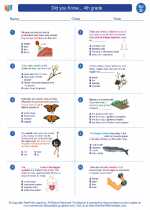 Did you Know... 4th grade Worksheet/Answer key
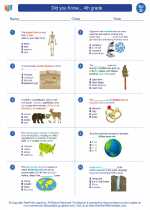 Did you Know... 4th grade Worksheet/Answer key
 Did you Know... 4th grade
Study GuideWorksheet/Answer keyWorksheet/Answer keyWorksheet/Answer keyThe resources above cover the following skills:
Core Ideas for Knowing Science
Life Science
Organisms are organized on a cellular basis and have a finite life span.