Bases
In chemistry, bases are substances that have a pH greater than 7. They are the opposite of acids, which have a pH lower than 7. Bases are also known as alkaline substances. They have a bitter taste and are slippery to the touch. Some common examples of bases include sodium hydroxide (NaOH), potassium hydroxide (KOH), and ammonia (NH3).
Properties of Bases
- Bases turn red litmus paper blue.
- They are proton acceptors, meaning they can accept hydrogen ions (H+) in a chemical reaction.
- Many bases are also good conductors of electricity when dissolved in water, as they produce hydroxide ions (OH-) which allow the flow of electric current.
- They have a soapy or slippery feel.
Common Bases
| Base | Chemical Formula |
|---|---|
| Sodium hydroxide | NaOH |
| Potassium hydroxide | KOH |
| Ammonia | NH3 |
Uses of Bases
Bases have various industrial and household uses. Some common applications include:
- Manufacture of soaps and detergents
- Neutralizing acidic substances
- Cleaning and disinfecting
- Controlling pH in agricultural practices
Study Guide
To study bases, it's important to understand their properties, common examples, and uses. Here are some key points to focus on:
- Define bases and their characteristics.
- Learn to identify bases using indicators such as litmus paper.
- Understand the concept of pH and how bases contribute to basic solutions.
- Memorize common examples of bases and their chemical formulas.
- Explore the various applications of bases in everyday life and industries.
◂Science Worksheets and Study Guides Fifth Grade. Plant Responses and Adaptations
Lesson Plan Plant Responses and Adaptations - Bundle
  Study Guide
 Plant Responses and Adaptations Activity Lesson
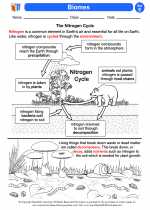 Biomes Worksheet/Answer key
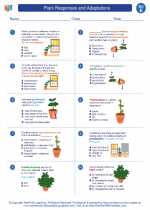 Plant Responses and Adaptations Worksheet/Answer key
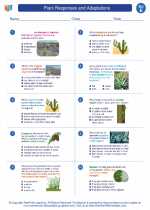 Plant Responses and Adaptations Worksheet/Answer key
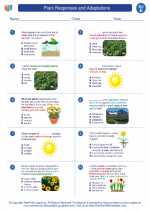 Plant Responses and Adaptations Vocabulary/Answer key
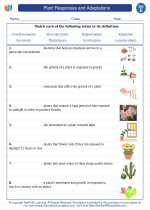 Plant Responses and Adaptations Vocabulary/Answer key
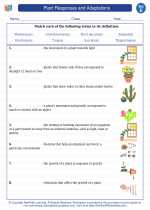 Plant Responses and Adaptations
Study GuideActivity LessonWorksheet/Answer keyWorksheet/Answer keyWorksheet/Answer keyVocabulary/Answer keyVocabulary/Answer keyThe resources above cover the following skills:
Life Science
Interdependence - A. Plants and animals, including humans, interact with and depend upon each other and their environment to satisfy their basic needs. B. Both human activities and natural events can have major impacts on the environment. C. Energy flows from the sun through producers to consumers.
Compare and contrast adaptations displayed by animals and plants that enable them to survive in different environments such as life cycles variations, animal behaviors and physical characteristics.