Respiration
Respiration is the process by which living organisms take in oxygen and release carbon dioxide. It is a vital process for all living organisms, as it is essential for the production of energy.
Types of Respiration
There are two main types of respiration: aerobic respiration and anaerobic respiration.
- Aerobic Respiration: This type of respiration occurs in the presence of oxygen and is the most efficient way to produce energy. It takes place in the mitochondria of cells and involves the breakdown of glucose to produce ATP (adenosine triphosphate).
- Anaerobic Respiration: This type of respiration occurs in the absence of oxygen. It is less efficient than aerobic respiration and produces lactic acid or ethanol as by-products.
The Respiratory System
The respiratory system is responsible for the exchange of gases (oxygen and carbon dioxide) between the body and the environment. It includes the lungs, diaphragm, and other structures involved in breathing.
Study Guide
- What is respiration?
- What are the two main types of respiration?
- Describe aerobic respiration and where it takes place in cells.
- Explain anaerobic respiration and its by-products.
- What is the role of the respiratory system in respiration?
◂Science Worksheets and Study Guides Sixth Grade. Magnetism
Lesson Plan Magnetism - Bundle
  Study Guide
 Magnetism Activity Lesson
 Magnetism Worksheet/Answer key
 Magnetism Worksheet/Answer key
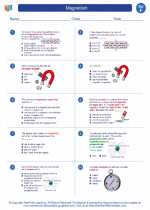 Magnetism Worksheet/Answer key
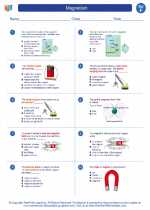 Magnetism Worksheet/Answer key
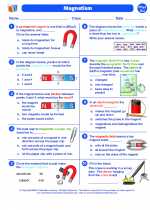 Magnetism Vocabulary/Answer key
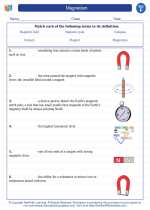 Magnetism
Study GuideActivity LessonWorksheet/Answer keyWorksheet/Answer keyWorksheet/Answer keyWorksheet/Answer keyVocabulary/Answer keyThe resources above cover the following skills:
EARTH AND SPACE SCIENCE
Earth’s Systems
Develop and use models of Earth’s interior composition to illustrate the resulting magnetic field (e.g., magnetic poles) and to explain its measureable effects (e.g., protection from cosmic radiation).