Isotopes
Isotopes are atoms of the same element that have the same number of protons but different numbers of neutrons. This means that isotopes of an element have the same atomic number but different atomic masses. For example, carbon has three isotopes: carbon-12, carbon-13, and carbon-14. These isotopes all have 6 protons, but they have 6, 7, and 8 neutrons, respectively.
Key Points:
- Isotopes have the same number of protons but different numbers of neutrons.
- Isotopes of an element have the same chemical properties but different physical properties.
- Isotopes are identified by their mass number, which is the sum of the protons and neutrons in the nucleus.
- Isotopes are used in various fields such as medicine, industry, and environmental science.
Study Guide:
When studying isotopes, it's important to understand the following:
- The definition of isotopes and how they differ from each other.
- How to calculate the number of protons, neutrons, and electrons in an isotope based on its mass number and atomic number.
- The uses of isotopes in various fields, such as carbon dating, medical imaging, and industrial applications.
- The concept of radioactive isotopes and their role in medicine and environmental studies.
- The notation used to represent isotopes, such as carbon-12, carbon-13, and carbon-14.
Understanding isotopes is crucial in the study of chemistry, physics, and environmental science. It's important to grasp the concept of isotopes and their significance in various scientific disciplines.
.◂Biology Worksheets and Study Guides High School. Human biology I
Worksheet/Answer key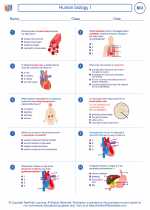 Human biology I
  Worksheet/Answer key
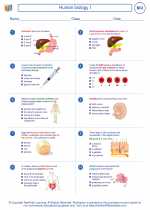 Human biology I Worksheet/Answer key
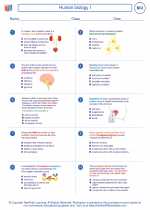 Human biology I Worksheet/Answer key
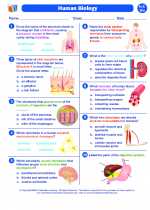 Human biology I Vocabulary/Answer key
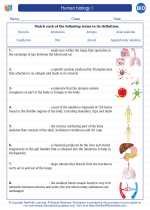 Human biology I Vocabulary/Answer key
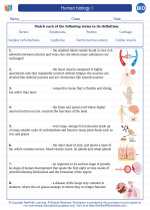 Human biology I Vocabulary/Answer key
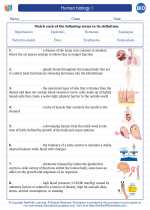 Human biology I Vocabulary/Answer key
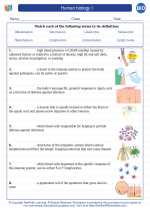 Human biology I Vocabulary/Answer key
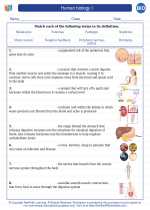 Human biology I Vocabulary/Answer key
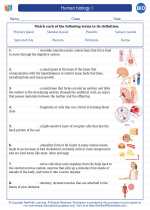 Human biology I Vocabulary/Answer key
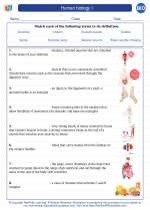 Human biology I
Worksheet/Answer keyWorksheet/Answer keyWorksheet/Answer keyVocabulary/Answer keyVocabulary/Answer keyVocabulary/Answer keyVocabulary/Answer keyVocabulary/Answer keyVocabulary/Answer keyVocabulary/Answer keyThe resources above cover the following skills:
LIFE SCIENCE (NGSS)
From Molecules to Organisms: Structures and Processes
Students who demonstrate understanding can:
Develop and use a model to illustrate the hierarchical organization of interacting systems that provide specific functions within multicellular organisms.
Plan and conduct an investigation to provide evidence that feedback mechanisms maintain homeostasis.