Topic: Solid
A solid is one of the four fundamental states of matter. Solids have a definite shape and volume, and their particles are closely packed together in a regular pattern. The particles in a solid vibrate in place, but do not have enough energy to overcome the attractive forces between them, which is what gives solids their fixed shape and volume.
Characteristics of Solids:
- Definite shape and volume: Unlike liquids and gases, solids have a fixed shape and volume, meaning they maintain their structure and size.
- Particle arrangement: The particles in a solid are tightly packed together in a regular, repeating pattern.
- Particle motion: While the particles in a solid do vibrate, they do not have enough energy to move past each other, which is why solids maintain their shape.
- Melting point: Solids have a specific temperature at which they melt and turn into a liquid.
- Examples: Examples of solids include ice, wood, metal, and plastic.
Study Guide:
To understand the concept of solids, it's important to focus on the following key points:
- Describe the characteristics of solids, including their shape, volume, particle arrangement, and motion.
- Explain the concept of melting point and how it relates to the transition from a solid to a liquid.
- Provide examples of common solids and their properties.
- Discuss the differences between solids, liquids, and gases in terms of particle behavior and arrangement.
- Explore the various uses and applications of solids in everyday life and industry.
Understanding the properties and behavior of solids is essential in the study of chemistry and physics, as well as in various practical applications in engineering, materials science, and other fields.
[Solid] Related Worksheets and Study Guides:
.◂Biology Worksheets and Study Guides High School. Human biology I
Worksheet/Answer key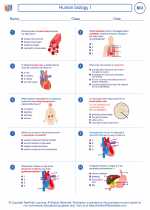 Human biology I
  Worksheet/Answer key
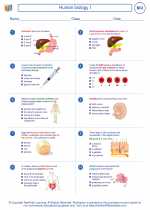 Human biology I Worksheet/Answer key
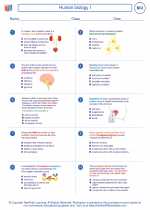 Human biology I Worksheet/Answer key
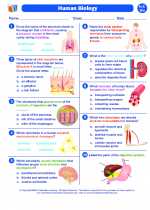 Human biology I Vocabulary/Answer key
 Human biology I Vocabulary/Answer key
 Human biology I Vocabulary/Answer key
 Human biology I Vocabulary/Answer key
 Human biology I Vocabulary/Answer key
 Human biology I Vocabulary/Answer key
 Human biology I Vocabulary/Answer key
 Human biology I
Worksheet/Answer keyWorksheet/Answer keyWorksheet/Answer keyVocabulary/Answer keyVocabulary/Answer keyVocabulary/Answer keyVocabulary/Answer keyVocabulary/Answer keyVocabulary/Answer keyVocabulary/Answer keyThe resources above cover the following skills:
LIFE SCIENCE (NGSS)
From Molecules to Organisms: Structures and Processes
Students who demonstrate understanding can:
Develop and use a model to illustrate the hierarchical organization of interacting systems that provide specific functions within multicellular organisms.
Plan and conduct an investigation to provide evidence that feedback mechanisms maintain homeostasis.