Antonyms
Antonyms are words that have opposite meanings. For example, the antonym of "hot" is "cold". Understanding antonyms can help you expand your vocabulary and improve your language skills.
Examples of Antonyms
Here are some examples of commonly used antonyms:
- Happy - Sad
- Fast - Slow
- Big - Small
- Good - Bad
- Up - Down
- Old - Young
How to Identify Antonyms
Antonyms can be identified by looking for words with opposite meanings in a sentence or a text. Sometimes, the antonym may be formed by adding a prefix such as "un-" or "dis-" to the word. For example, "happy" can become "unhappy" to form an antonym.
Practice Exercises
Here are some practice exercises to help you understand and identify antonyms:
- Identify the antonym for each word:
a) Big
b) Tall
c) True
d) Love
e) Fast - Form an antonym for the following words:
a) Kind
b) Like
c) Agree
d) Happy
e) Organized - Use the antonyms in sentences:
a) Use "hot" and its antonym in a sentence.
b) Use "old" and its antonym in a sentence.
c) Use "fast" and its antonym in a sentence.
Additional Tips
Here are some additional tips to help you master antonyms:
- Read regularly and pay attention to words with opposite meanings.
- Practice using antonyms in your writing to improve your language skills.
- Use a thesaurus to find antonyms for words you are familiar with.
[Antonyms] Related Worksheets and Study Guides:
.◂English Language Arts Worksheets and Study Guides Fourth Grade. Synonyms/Antonyms
Worksheet/Answer key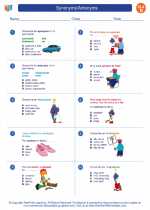 Synonyms/Antonyms
  Worksheet/Answer key
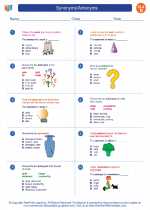 Synonyms/Antonyms Worksheet/Answer key
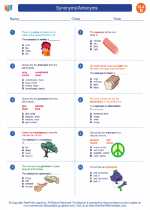 Synonyms/Antonyms Worksheet/Answer key
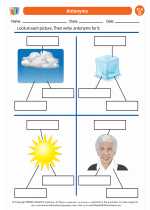 Antonyms
Worksheet/Answer keyWorksheet/Answer keyWorksheet/Answer keyThe resources above cover the following skills:
Language Standards
Vocabulary Acquisition and Use
Demonstrate understanding of figurative language, word relationships, and nuances in word meanings. [L.4.5]
Demonstrate understanding of words by relating them to their opposites (antonyms) and to words with similar but not identical meanings (synonyms). [L.4.5c]