Pronouns
A pronoun is a word that takes the place of a noun in a sentence. Pronouns are used to avoid repeating the same noun over and over again. They can refer to people, places, things, or ideas.
Types of Pronouns:
- Personal Pronouns: Refer to specific people or things. (e.g. I, you, he, she, it, we, they)
- Reflexive Pronouns: End in "-self" or "-selves" and refer back to the subject of the sentence. (e.g. myself, yourself, himself, herself, itself, ourselves, themselves)
- Demonstrative Pronouns: Point out specific things. (e.g. this, that, these, those)
- Interrogative Pronouns: Used to ask questions. (e.g. who, whom, whose, which, what)
- Indefinite Pronouns: Refer to non-specific people or things. (e.g. anyone, someone, everyone, nobody, anything, everything)
- Relative Pronouns: Introduce relative clauses and connect them to the main clause. (e.g. who, whom, whose, which, that)
Examples:
1. Personal Pronoun: She is going to the store.
2. Reflexive Pronoun: They dressed themselves for the party.
3. Demonstrative Pronoun: This is my favorite book.
4. Interrogative Pronoun: Whose shoes are these?
5. Indefinite Pronoun: Everyone is invited to the event.
6. Relative Pronoun: The dog that barked is brown.
Study Tips:
- Identify the type of pronoun used in a sentence.
- Practice replacing nouns with pronouns in sentences.
- Use pronouns to avoid repetition and make sentences more concise.
[Pronoun] Related Worksheets and Study Guides:
.◂English Language Arts Worksheets and Study Guides Fourth Grade. Vivid Language in Writing
Study Guide Vivid Language in Writing
  Worksheet/Answer key
 Vivid Language in Writing Worksheet/Answer key
 Vivid Language in Writing Worksheet/Answer key
 Vivid Language in Writing Worksheet/Answer key
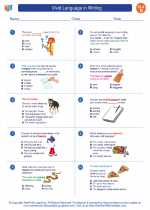 Vivid Language in Writing Worksheet/Answer key
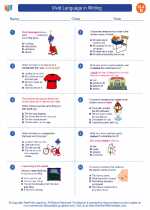 Vivid Language in Writing Worksheet/Answer key
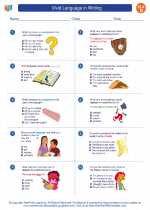 Vivid Language in Writing Worksheet/Answer key
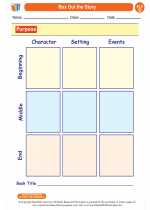 Box Out the Story
Worksheet/Answer keyWorksheet/Answer keyWorksheet/Answer keyWorksheet/Answer keyWorksheet/Answer keyWorksheet/Answer keyWorksheet/Answer keyThe resources above cover the following skills:
Students conduct research on issues and interests by generating ideas and questions, and by posing problems. They gather, evaluate, and synthesize data from a variety of sources (e.g., print and nonprint texts, artifacts, people) to communicate their discoveries in ways that suit their purpose and audience. (NCTE)