Helping Verbs Study Guide
What are Helping Verbs?
Helping verbs, also known as auxiliary verbs, are used in combination with main verbs to express shades of meaning and time. They "help" the main verb by adding extra information about the action or state of being.
Examples of Helping Verbs
Common helping verbs include: am, is, are, was, were, be, being, been, have, has, had, do, does, did, can, could, shall, should, will, would, may, might, must.
Functions of Helping Verbs
- Expressing Tense: Helping verbs indicate the time of the action or state of being. For example: He is studying for the test. (Present tense)
- Forming Questions: Helping verbs are used to form questions. For example: Are you coming to the party?
- Forming Negatives: Helping verbs are used to create negative statements. For example: She does not like spinach.
- Expressing Possibility or Necessity: Helping verbs can express possibility or necessity. For example: You must finish your homework.
Identifying Helping Verbs
To identify a helping verb, look for a verb that is combined with another verb to form a complete verb phrase. For example: She is singing beautifully.
Practice Exercise
Identify the helping verbs in the following sentences:
- They have finished their homework.
- We are going to the park.
- He has read that book already.
- She will be cooking dinner tonight.
[Helping Verbs] Related Worksheets and Study Guides:
.◂English Language Arts Worksheets and Study Guides Fifth Grade. Implied Information
Worksheet/Answer key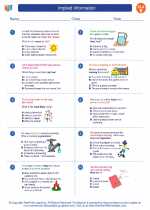 Implied Information
  Worksheet/Answer key
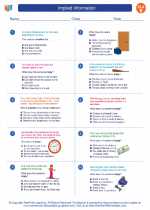 Implied Information Worksheet/Answer key
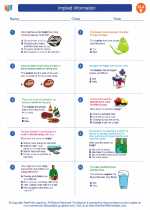 Implied Information
Worksheet/Answer keyWorksheet/Answer keyThe resources above cover the following skills:
Students apply a wide range of strategies to comprehend, interpret, evaluate, and appreciate texts. They draw on their prior experience, their interactions with other readers and writers, their knowledge of word meaning and of other texts, their word identification strategies, and their understanding of textual features (e.g., sound-letter correspondence, sentence structure, context, graphics). (NCTE)
Students apply knowledge of language structure, language conventions (e.g., spelling and punctuation), media techniques, figurative language, and genre to create, critique, and discuss print and nonprint texts. (NCTE)