Quotations
A quotation is a group of words taken from a text or speech and repeated by someone other than the original author or speaker. Quotations are used for various purposes in writing, such as to provide evidence, support an argument, or to give credit to the original source.
Types of Quotations
- Direct Quotations: These are the exact words of the original author or speaker and are enclosed in quotation marks.
- Indirect Quotations: These are paraphrased versions of the original words and do not need to be enclosed in quotation marks.
Usage of Quotations
Quotations are commonly used in various types of writing, including essays, research papers, and articles. They serve the following purposes:
- To support an argument or claim with evidence from a credible source.
- To add credibility to the writer's ideas by referencing experts or authoritative figures.
- To highlight a memorable or impactful statement from a source.
- To give credit to the original author or speaker for their words.
Study Guide
Here are some key points to remember when using quotations:
- Always use quotation marks for direct quotations.
- Introduce the quotation with a signal phrase to provide context and attribution.
- Cite the source of the quotation using the appropriate formatting style (e.g., MLA, APA).
- Ensure that the quotation seamlessly integrates with the surrounding text and follows the grammatical rules of the sentence.
- Use quotations sparingly and strategically, focusing on the most impactful or relevant passages.
Remember that using quotations effectively can enhance the quality and credibility of your writing, so it's important to understand when and how to incorporate them into your work.
[Quotations] Related Worksheets and Study Guides:
.◂English Language Arts Worksheets and Study Guides Fifth Grade. Opinion/Exaggeration/Missing Info
Worksheet/Answer key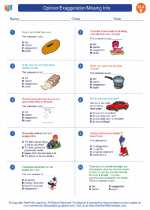 Opinion/Exaggeration/Missing Info.
  Worksheet/Answer key
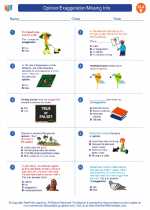 Opinion/Exaggeration/Missing Info. Worksheet/Answer key
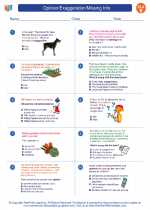 Opinion/Exaggeration/Missing Info.
Worksheet/Answer keyWorksheet/Answer keyThe resources above cover the following skills:
Reading Standards for Literature
Craft and Structure
Determine the meaning of words and phrases as they are used in a text, including use of figurative language and literary devices (e.g., imagery, metaphors, analogies, hyperbole).