Verb Study Guide
What is a Verb?
A verb is a word that describes an action, occurrence, or state of being. It is a crucial part of a sentence, as it tells us what the subject of the sentence is doing or what is happening to the subject.
Types of Verbs
There are several types of verbs, including:
- Action Verbs: These verbs express physical or mental actions. For example: run, jump, think, believe.
- Linking Verbs: Linking verbs connect the subject of the sentence to a subject complement, which can be a noun, pronoun, or adjective. For example: am, is, are, was, were, seem, appear.
- Helping Verbs: Also known as auxiliary verbs, helping verbs work in conjunction with the main verb to express shades of time and mood. For example: will, can, may, have, be.
- Transitive Verbs: These verbs require a direct object to complete their meaning. For example: eat, write, read.
- Intransitive Verbs: These verbs do not require a direct object to complete their meaning. For example: laugh, cry, sleep.
Verb Tenses
Verbs can also change form to indicate the time of the action or state of being. There are three primary verb tenses:
- Present Tense: Indicates an action that is happening now or a state that is currently true. For example: I walk to school. She loves ice cream.
- Past Tense: Indicates an action that has already happened. For example: I walked to school. She loved ice cream.
- Future Tense: Indicates an action that will happen in the future. For example: I will walk to school. She will love ice cream.
Subject-Verb Agreement
Verbs must agree with their subjects in number (singular or plural). For example, "He plays" is correct, while "He play" is incorrect.
Verb Usage Tips
Here are some important points to remember when using verbs:
- Use the correct verb tense to convey the timing of an action or state.
- Ensure that the verb agrees with the subject in number and person.
- Use linking verbs to connect the subject to a subject complement.
- Choose transitive or intransitive verbs based on whether the action requires a direct object.
[Verb] Related Worksheets and Study Guides:
.◂English Language Arts Worksheets and Study Guides Fifth Grade. Opinion/Exaggeration/Missing Info
Worksheet/Answer key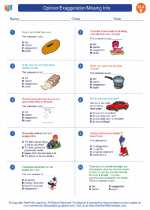 Opinion/Exaggeration/Missing Info.
  Worksheet/Answer key
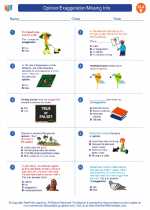 Opinion/Exaggeration/Missing Info. Worksheet/Answer key
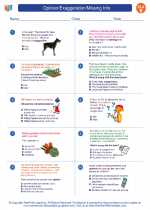 Opinion/Exaggeration/Missing Info.
Worksheet/Answer keyWorksheet/Answer keyThe resources above cover the following skills:
Reading Standards for Literature
Craft and Structure
Determine the meaning of words and phrases as they are used in a text, including use of figurative language and literary devices (e.g., imagery, metaphors, analogies, hyperbole).