Vowels: An Explanation and Study Guide
What are Vowels?
Vowels are speech sounds that are produced without any significant constriction or closure in the vocal tract. They are formed by the unrestricted flow of air through the throat and mouth. In the English language, the vowels are the letters A, E, I, O, U, and sometimes Y.
Types of Vowels
Vowels can be classified into two main types: short vowels and long vowels. Short vowels are typically pronounced for a shorter duration, while long vowels are pronounced for a longer duration. Additionally, there are also diphthongs, which are combinations of two vowel sounds within the same syllable.
Study Guide
Here are some key points to remember when studying vowels:
- Vowel Sounds: Understand the different sounds that each vowel can make. For example, the letter A can make both the short /æ/ sound (as in "cat") and the long /eɪ/ sound (as in "cake").
- Short vs. Long Vowels: Practice identifying and differentiating between short and long vowel sounds. For instance, the word "pat" contains a short /æ/ sound, while the word "pate" contains a long /eɪ/ sound.
- Diphthongs: Learn about diphthongs and how they are formed. Practice recognizing and pronouncing words that contain diphthongs, such as "coin" or "loud."
- Spelling Patterns: Familiarize yourself with common spelling patterns for vowel sounds, such as the "magic e" rule (e.g., "cute" vs. "cut").
- Word Families: Explore word families that share the same vowel sound, such as the "at" family (e.g., "cat," "bat," "hat").
By understanding the different types of vowels, their sounds, and their spelling patterns, you'll be better equipped to read, write, and pronounce words accurately in the English language.
[Vowel] Related Worksheets and Study Guides:
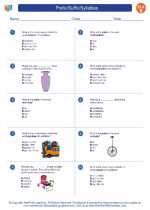
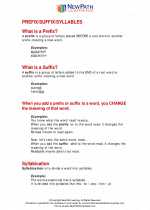
.◂English Language Arts Worksheets and Study Guides Fifth Grade. Prefix/Suffix/Syllables
 Worksheet/Answer key
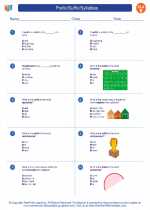 Worksheet/Answer key
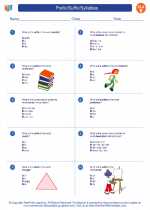 Worksheet/Answer key