Modal Verbs
Modal verbs are a type of auxiliary verb used to express modality – the speaker's attitude towards the likelihood or necessity of the action in the main verb. Modal verbs are used to indicate possibility, necessity, ability, permission, and obligation. They are always followed by a base verb (bare infinitive).
Common Modal Verbs
- Can: Indicates ability or possibility, e.g. "I can swim."
- Could: Indicates past ability or polite requests, e.g. "Could you pass the salt?"
- May: Indicates permission or possibility, e.g. "May I go to the restroom?"
- Might: Indicates possibility or uncertainty, e.g. "It might rain tomorrow."
- Must: Indicates necessity or strong obligation, e.g. "You must finish your homework."
- Should: Indicates suggestion or advice, e.g. "You should eat more vegetables."
- Would: Indicates polite requests or hypothetical situations, e.g. "Would you like some tea?"
- Will: Indicates future action or willingness, e.g. "I will help you with your project."
- Shall: Indicates future action in formal or legal contexts, e.g. "We shall overcome."
Study Guide for Modal Verbs
- Understand the purpose of modal verbs: Explain how modal verbs express modality and the different meanings they convey.
- Learn the usage of each modal verb: Provide examples and explanations for when to use can, could, may, might, must, should, would, will, and shall.
- Practice forming sentences: Ask students to create sentences using modal verbs to convey different meanings (e.g. ability, permission, obligation).
- Discuss exceptions and variations: Explain that modal verbs do not change form for different subjects, and discuss the concept of "semi-modals" such as need to, have to, and ought to.
- Review modal verb contractions: Show how can not becomes can't, could not becomes couldn't, and so on.
Modal verbs are an important part of English grammar and are used in a wide variety of contexts. Understanding their usage and meaning is essential for effective communication in both spoken and written English.
[Modal Verbs] Related Worksheets and Study Guides:
.◂English Language Arts Worksheets and Study Guides Seventh Grade. Author's Purpose
Study Guide Author's Purpose
  Activity Lesson
 Author's Purpose & Point of View Worksheet/Answer key
 Author's Purpose Worksheet/Answer key
 Author's Purpose Worksheet/Answer key
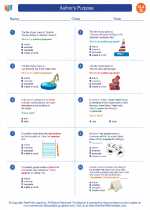 Author's Purpose Worksheet/Answer key
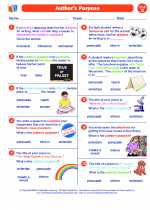 Author's Purpose
Activity LessonWorksheet/Answer keyWorksheet/Answer keyWorksheet/Answer keyWorksheet/Answer keyThe resources above cover the following skills:
Reading Standards for Informational Text
Craft and Structure
Determine an author’s point of view or purpose in a text and analyze how the author distinguishes his or her position from that of others. [RI.7.6]