Verbs
Verbs are the action words in a sentence. They describe what the subject of the sentence is doing. Verbs can also show a state of being or a condition. Understanding verbs is essential for constructing meaningful sentences.
Types of Verbs
There are several types of verbs:
- Action Verbs: These verbs express physical or mental actions. For example: run, think, eat.
- Linking Verbs: These verbs connect the subject of a sentence to a noun or an adjective that describes the subject. For example: am, is, are, seem, feel.
- Helping Verbs: These verbs come before the main verb and help to express the time, mood, or voice of the main verb. For example: have, be, do.
- Modal Verbs: These verbs are used to express necessity, possibility, ability, or permission. For example: can, could, may, might.
Verb Tenses
Verbs also have different tenses to indicate the time of an action or state of being. The basic tenses include:
- Present Tense: Describes actions happening currently or general truths.
- Past Tense: Describes actions that have already happened.
- Future Tense: Describes actions that will happen in the future.
Study Guide
Here are some tips for studying verbs:
- Identify verbs in sentences and determine their type (action, linking, helping, modal).
- Practice conjugating verbs in different tenses (present, past, future).
- Use verbs in context by writing sentences or short paragraphs.
- Learn irregular verbs and their past tense forms.
- Understand the role of verbs in sentence structure and how they interact with subjects and objects.
Understanding verbs and their usage is crucial for effective communication and writing. Mastering verbs will enhance your ability to convey actions, describe states of being, and express various nuances in language.
[Verbs] Related Worksheets and Study Guides:
.◂English Language Arts Worksheets and Study Guides Seventh Grade. Modifiers-Adjectives
Study Guide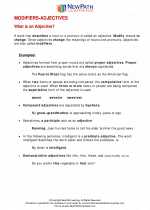 Modifiers-Adjectives
  Activity Lesson
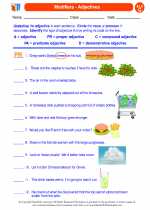 Modifiers - Adjectives Worksheet/Answer key
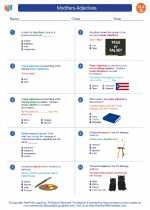 Modifiers-Adjectives Worksheet/Answer key
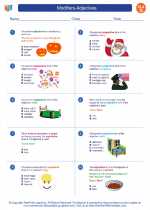 Modifiers-Adjectives Worksheet/Answer key
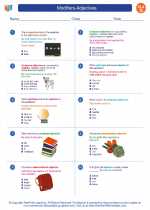 Modifiers-Adjectives
Activity LessonWorksheet/Answer keyWorksheet/Answer keyWorksheet/Answer keyThe resources above cover the following skills:
Language Standards
Conventions of Standard English
Demonstrate command of the conventions of Standard English grammar and usage when writing or speaking. [L.7.1]
Place phrases and clauses within a sentence, recognizing and correcting misplaced and dangling modifiers. [L.7.1c]