Adjectives Study Guide
Adjectives are words that describe or modify nouns and pronouns. They provide more information about the noun or pronoun they modify by answering questions such as "What kind?", "Which one?", "How many?", or "How much?".
Types of Adjectives
There are several types of adjectives:
- Descriptive Adjectives: These adjectives describe the qualities or characteristics of a noun. For example, "beautiful", "tall", "smart".
- Demonstrative Adjectives: These adjectives point out specific nouns and include words like "this", "that", "these", and "those".
- Quantitative Adjectives: These adjectives give information about the quantity of the noun and include words like "many", "few", "several".
- Possessive Adjectives: These adjectives show ownership and include words like "my", "your", "his", "her", "our", "their".
- Interrogative Adjectives: These adjectives are used to ask questions and include words like "which", "what", "whose".
- Indefinite Adjectives: These adjectives refer to non-specific nouns and include words like "some", "any", "several", "all".
Usage of Adjectives
Adjectives can be used before a noun or after linking verbs such as "be", "seem", "appear", "become", and "feel". When using more than one adjective to describe a noun, they should be used in a specific order: opinion, size, age, shape, color, origin, material, purpose.
Practice Exercises
Now that you've learned about adjectives, it's time to practice! Here are some exercises to help reinforce your understanding:
- Identify the adjectives in the following sentences:
- The blue car drove quickly down the winding road.
- She has three beautiful antique vases on her shelf.
- Write a sentence using at least three different types of adjectives.
- Create a chart categorizing different adjectives into their respective types.
Summary
Adjectives are essential for adding detail and description to our language. By understanding the different types of adjectives and their usage, you can enhance your writing and communication skills.
[Adjectives] Related Worksheets and Study Guides:
.◂English Language Arts Worksheets and Study Guides Eighth Grade. Gerunds, Infinitives, and Participles
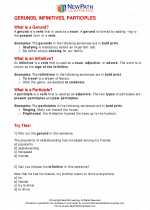
 Worksheet/Answer key
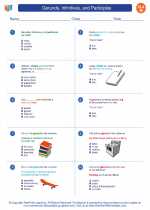 Worksheet/Answer key
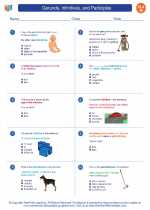 Worksheet/Answer key