George Orwell
George Orwell was an English novelist, essayist, journalist, and critic best known for his dystopian novel "Nineteen Eighty-Four" and the allegorical novella "Animal Farm". His works are known for their social and political commentary, as well as their critique of totalitarianism and oppressive regimes.
Biography
George Orwell, whose real name was Eric Arthur Blair, was born on June 25, 1903, in Motihari, India. He is considered one of the most influential writers of the 20th century. Orwell's experiences as a colonial policeman in Burma, his observations of working-class life in northern England, and his passion for social justice greatly influenced his writing.
Notable Works
- Nineteen Eighty-Four: A dystopian novel that explores the dangers of totalitarianism, mass surveillance, and government oppression.
- Animal Farm: An allegorical novella that satirizes the Russian Revolution and Stalinist Russia.
- Homage to Catalonia: Orwell's personal account of his experiences and observations during the Spanish Civil War.
- Down and Out in Paris and London: A memoir detailing Orwell's experiences living among the poor and destitute in the two cities.
Themes and Motifs
Orwell's works often explore themes such as the dangers of totalitarianism, the corrupting influence of power, the loss of individuality, and the perversion of language for political ends. Motifs such as surveillance, propaganda, and the manipulation of truth are also prevalent in his writing.
Study Guide
- Read "Nineteen Eighty-Four" and analyze the use of language as a tool of oppression.
- Compare and contrast the characters and events in "Animal Farm" with real-life historical figures and events.
- Explore the historical and social context of Orwell's works, particularly in relation to the rise of totalitarian regimes in the 20th century.
- Examine Orwell's use of satire and allegory in "Animal Farm" to critique political systems and human nature.
◂English Language Arts Worksheets and Study Guides Eighth Grade. Titles and Authors
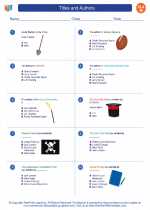
 Worksheet/Answer key
 Worksheet/Answer key
 Worksheet/Answer key