Fractions
A fraction represents a part of a whole or a part of a group. It consists of a numerator and a denominator, separated by a horizontal line. The numerator represents the number of parts we have, while the denominator represents the total number of parts that make up a whole.
Types of Fractions
There are different types of fractions:
- Proper Fractions: When the numerator is less than the denominator, e.g., 1/2, 3/4.
- Improper Fractions: When the numerator is greater than or equal to the denominator, e.g., 5/3, 7/4.
- Mixed Numbers: A combination of a whole number and a fraction, e.g., 2 1/3, 3 2/5.
- Equivalent Fractions: Fractions that represent the same part of a whole, e.g., 1/2 and 2/4 are equivalent.
Operations with Fractions
We can perform various operations with fractions:
- Addition and Subtraction: When adding or subtracting fractions, we need to have a common denominator.
- Multiplication: To multiply fractions, we simply multiply the numerators and denominators together.
- Division: To divide fractions, we multiply by the reciprocal of the divisor.
Examples
Here are some examples of fractions:
- 1/2 - One-half of a whole.
- 3/4 - Three-fourths of a whole.
- 2 1/3 - Two and one-third, a mixed number.
- 5/6 + 1/3 = 9/6 - Adding fractions with a common denominator.
- 2/3 * 4/5 = 8/15 - Multiplying fractions.
- 3/4 ÷ 2/5 = 15/8 - Dividing fractions by multiplying by the reciprocal.
[Fractions] Related Worksheets and Study Guides:
.◂Math Worksheets and Study Guides Second Grade. Daily Spiral Review (30)
Worksheet/Answer key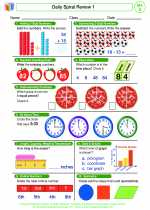 Daily Spiral Review 1, Grade 2
  Worksheet/Answer key
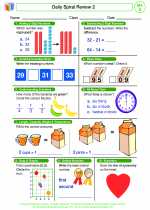 Daily Spiral Review 2, Grade 2 Worksheet/Answer key
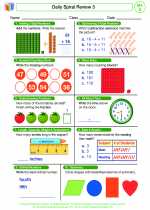 Daily Spiral Review 3, Grade 2 Worksheet/Answer key
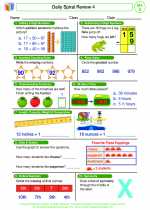 Daily Spiral Review 4, Grade 2 Worksheet/Answer key
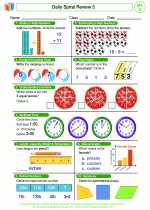 Daily Spiral Review 5, Grade 2 Worksheet/Answer key
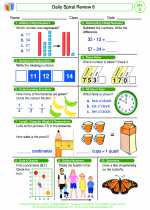 Daily Spiral Review 6, Grade 2 Worksheet/Answer key
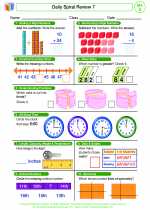 Daily Spiral Review 7, Grade 2 Worksheet/Answer key
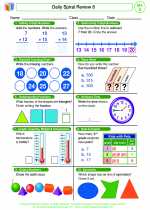 Daily Spiral Review 8, Grade 2 Worksheet/Answer key
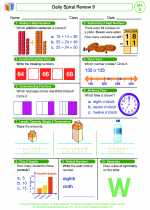 Daily Spiral Review 9, Grade 2 Worksheet/Answer key
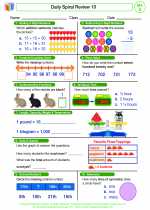 Daily Spiral Review 10, Grade 2 Worksheet/Answer key
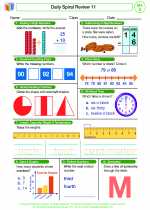 Daily Spiral Review 11, Grade 2 Worksheet/Answer key
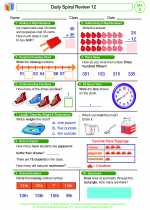 Daily Spiral Review 12, Grade 2 Worksheet/Answer key
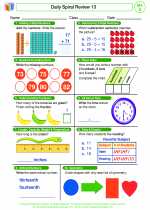 Daily Spiral Review 13, Grade 2 Worksheet/Answer key
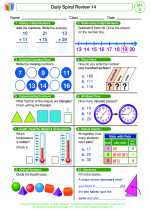 Daily Spiral Review 14, Grade 2 Worksheet/Answer key
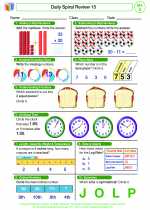 Daily Spiral Review 15, Grade 2 Worksheet/Answer key
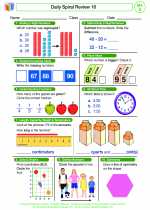 Daily Spiral Review 16, Grade 2 Worksheet/Answer key
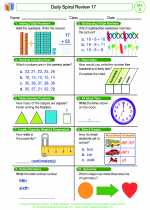 Daily Spiral Review 17, Grade 2 Worksheet/Answer key
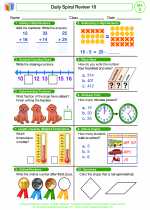 Daily Spiral Review 18, Grade 2 Worksheet/Answer key
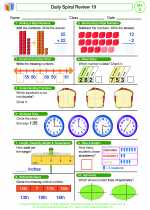 Daily Spiral Review 19, Grade 2 Worksheet/Answer key
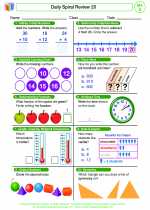 Daily Spiral Review 20, Grade 2 Worksheet/Answer key
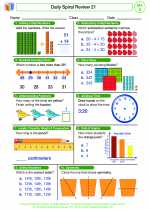 Daily Spiral Review 21, Grade 2 Worksheet/Answer key
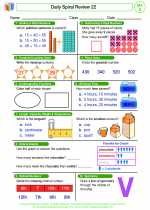 Daily Spiral Review 22, Grade 2 Worksheet/Answer key
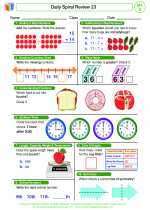 Daily Spiral Review 23, Grade 2 Worksheet/Answer key
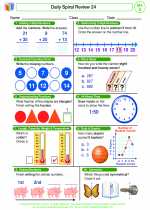 Daily Spiral Review 24, Grade 2 Worksheet/Answer key
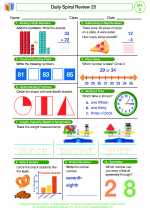 Daily Spiral Review 25, Grade 2 Worksheet/Answer key
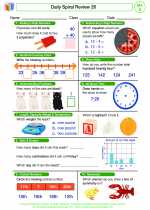 Daily Spiral Review 26, Grade 2 Worksheet/Answer key
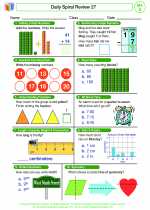 Daily Spiral Review 27, Grade 2 Worksheet/Answer key
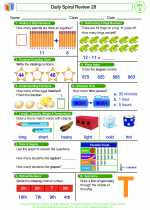 Daily Spiral Review 28, Grade 2 Worksheet/Answer key
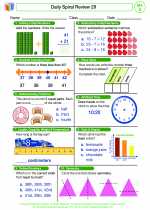 Daily Spiral Review 29, Grade 2 Worksheet/Answer key
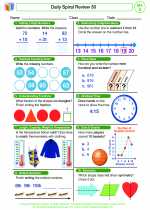 Daily Spiral Review 30, Grade 2
Worksheet/Answer keyWorksheet/Answer keyWorksheet/Answer keyWorksheet/Answer keyWorksheet/Answer keyWorksheet/Answer keyWorksheet/Answer keyWorksheet/Answer keyWorksheet/Answer keyWorksheet/Answer keyWorksheet/Answer keyWorksheet/Answer keyWorksheet/Answer keyWorksheet/Answer keyWorksheet/Answer keyWorksheet/Answer keyWorksheet/Answer keyWorksheet/Answer keyWorksheet/Answer keyWorksheet/Answer keyWorksheet/Answer keyWorksheet/Answer keyWorksheet/Answer keyWorksheet/Answer keyWorksheet/Answer keyWorksheet/Answer keyWorksheet/Answer keyWorksheet/Answer keyWorksheet/Answer key