Equality in Mathematics
Equality is a fundamental concept in mathematics that signifies the balance or equivalence between two mathematical expressions or values. It is denoted by the equal sign (=), which indicates that the expressions or values on both sides of the equal sign are the same.
Understanding the Equal Sign
When we write an equation such as 3 + 4 = 7, it means that the sum of 3 and 4 is equal to 7. The equal sign shows that both sides of the equation have the same value. In other words, equality implies that both sides are balanced and identical.
Properties of Equality
There are certain properties that govern equality in mathematics:
- Reflexive Property: For any real number 'a', a = a. In other words, any value is equal to itself.
- Symmetric Property: If a = b, then b = a. The order of the values does not affect their equality.
- Transitive Property: If a = b and b = c, then a = c. This property allows us to chain equalities together.
- Addition Property of Equality: If a = b, then a + c = b + c. This property states that adding the same number to both sides of an equation preserves equality.
- Multiplication Property of Equality: If a = b, then a * c = b * c. Similar to the addition property, multiplying both sides of an equation by the same number maintains equality.
Study Guide for Equality
Here are some key points to remember when studying equality in mathematics:
- Understand the meaning of the equal sign and how it relates to balance and equivalence.
- Practice identifying and writing equations that represent equality.
- Learn and apply the properties of equality in solving equations.
- Work on exercises involving the addition and multiplication properties of equality.
- Explore real-life examples of equality, such as balancing equations in chemistry or solving for unknown quantities in physics.
By mastering the concept of equality and its properties, you will develop a strong foundation for solving equations and understanding the fundamental principles of mathematics.
[Equality] Related Worksheets and Study Guides:
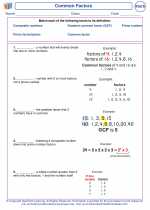
.◂Math Worksheets and Study Guides Fifth Grade. Common Factors
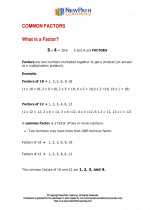
 Worksheet/Answer key
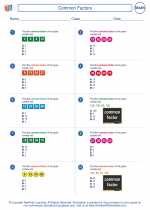 Worksheet/Answer key
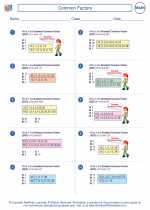 Worksheet/Answer key
 Worksheet/Answer key
 Worksheet/Answer key
 Worksheet/Answer key
 Vocabulary/Answer key