Numeric Patterns
Numeric patterns are sequences of numbers that follow a specific rule or pattern. Recognizing and understanding these patterns is important in mathematics and can help in solving problems and making predictions.
Types of Numeric Patterns
There are several types of numeric patterns, including:
- Arithmetic Patterns: In an arithmetic pattern, each term is obtained by adding or subtracting a constant value from the previous term. The constant value is called the "common difference."
- Geometric Patterns: In a geometric pattern, each term is obtained by multiplying or dividing by a constant value, known as the "common ratio."
- Square Numbers: A sequence of numbers where each term is the result of squaring the natural numbers (1, 4, 9, 16, ...).
- Cube Numbers: A sequence of numbers where each term is the result of cubing the natural numbers (1, 8, 27, 64, ...).
Identifying and Extending Numeric Patterns
To identify and extend numeric patterns, follow these steps:
- Examine the given sequence of numbers to look for a recurring operation or relationship between the terms.
- Use the identified pattern to predict and extend the sequence by finding the next few terms.
- Verify the extended sequence by applying the pattern to check if the predicted terms fit the pattern.
Example:
Given the sequence 3, 6, 9, 12, ..., identify the pattern and extend the sequence.
Solution: The pattern is an arithmetic sequence with a common difference of 3. To extend the sequence, the next few terms would be 15, 18, 21, and so on, by adding 3 to each previous term.
Practice Questions
1. Identify the type of pattern and extend the sequence: 2, 4, 8, 16, ...
2. Find the next three terms in the sequence: 5, 10, 20, 40, ...
3. Identify the type of pattern and extend the sequence: 1, 4, 9, 16, ...
Hope this study guide helps! Let me know if you need further assistance or more practice questions.
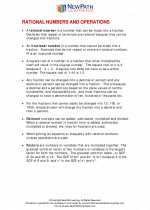
.◂Math Worksheets and Study Guides Eighth Grade. Rational numbers and operations
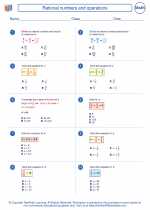
 Worksheet/Answer key
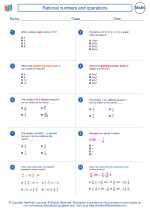 Worksheet/Answer key
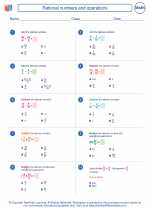 Worksheet/Answer key