Key Concepts in Taxonomy
- Classification: The process of grouping organisms based on their shared characteristics.
- Hierarchy: Taxonomy uses a hierarchical system to organize organisms into groups, from broad categories to specific ones.
- Binomial nomenclature: The system of naming species using a two-part Latin name, with the genus and species names.
- Taxonomic keys: Tools used to identify organisms based on their characteristics.
The Taxonomic Hierarchy
The taxonomic hierarchy is a system for organizing and classifying organisms into increasingly specific categories. The main levels of the hierarchy, from broadest to most specific, are:
Binomial Nomenclature
Each species is given a unique, two-part Latin name according to binomial nomenclature. The first part is the genus name, and the second part is the specific epithet. For example, humans are classified as Homo sapiens.
Why is Taxonomy Important?
Taxonomy helps scientists organize and understand the diversity of life on Earth. By classifying and naming organisms, we can better study and communicate about them. Understanding the relationships between different species also helps in fields such as ecology, evolution, and conservation.
Study Guide for Taxonomy
To study taxonomy effectively, it's important to:
- Learn and understand the taxonomic hierarchy and how organisms are classified at each level.
- Practice using taxonomic keys to identify different organisms.
- Memorize and understand the rules of binomial nomenclature and how species are named.
- Study examples of different organisms and their classifications to see how taxonomy is applied in real life.
◂Science Worksheets and Study Guides Fourth Grade. Cells: The Building Blocks of Living Things
Lesson Plan Cells: The Building Blocks of Living Things - Bundle
  Study Guide
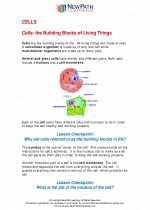 Cells- The building blocks of living things Activity Lesson
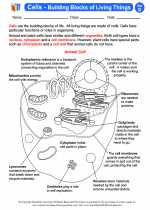 Cells - Building Blocks of Living Things Worksheet/Answer key
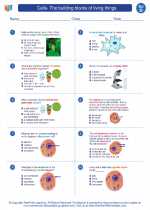 Cells- The building blocks of living things Worksheet/Answer key
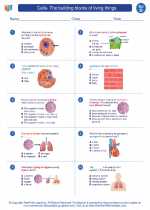 Cells- The building blocks of living things Worksheet/Answer key
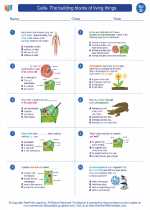 Cells- The building blocks of living things Worksheet/Answer key
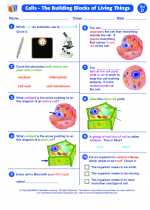 Cells - The Building Blocks of Living Things Worksheet/Answer key
 Focus In Vocabulary/Answer key
 Cells- The building blocks of living things Vocabulary/Answer key
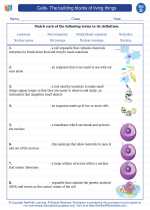 Cells- The building blocks of living things Vocabulary/Answer key
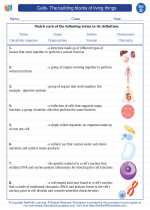 Cells- The building blocks of living things
Study GuideActivity LessonWorksheet/Answer keyWorksheet/Answer keyWorksheet/Answer keyWorksheet/Answer keyWorksheet/Answer keyVocabulary/Answer keyVocabulary/Answer keyVocabulary/Answer keyThe resources above cover the following skills:
The Living Environment: Students understand that cells are the basic unit of life, that all life as we know it has evolved through genetic transfer and natural selection to create a great diversity of organisms, and that these organisms create interdependent webs through which matter and energy flow. Students understand similarities and differences between humans and other organisms and the interconnections of these interdependent webs.
Cells: Students describe how living things are made up of one or more cells and the ways cells help organisms meet their basic needs.
Give examples of organisms that consist of a single cell and organisms that are made of a collection of cells.