Natural Selection
Definition
Natural selection is the process by which organisms that are better adapted to their environment tend to survive and produce more offspring. This leads to the perpetuation of favorable genetic traits in a population over time.
Mechanism
Natural selection operates through the following mechanisms:
- Variation: Within a population, individuals exhibit variation in their traits, such as size, color, or behavior.
- Heritability: Some of these traits are inherited and can be passed on to offspring.
- Differential Reproduction: Organisms with advantageous traits are more likely to survive and reproduce, passing on their favorable traits to the next generation.
Examples
Some examples of natural selection in action include the peppered moth in England, where darker moths became more prevalent during the industrial revolution due to camouflage advantages, and the Galapagos finches studied by Charles Darwin, which exhibited different beak shapes based on their food sources.
Study Guide
- Define natural selection and explain its significance in shaping the diversity of life on Earth.
- Describe the mechanisms through which natural selection operates, using specific examples to illustrate each mechanism.
- Analyze how environmental pressures can lead to the evolution of specific traits in a population over time.
- Compare and contrast natural selection with other mechanisms of evolution, such as genetic drift and gene flow.
- Discuss the role of adaptation and fitness in the process of natural selection.
[Natural Selection] Related Worksheets and Study Guides:
.◂Science Worksheets and Study Guides Sixth Grade. Earth's Fresh Water
Lesson Plan Earth's Fresh Water - Bundle
  Study Guide
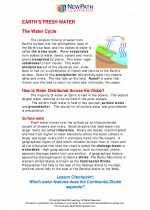 Earth's Fresh Water Worksheet/Answer key
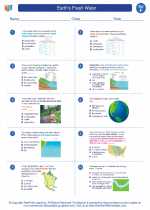 Earth's Fresh Water Worksheet/Answer key
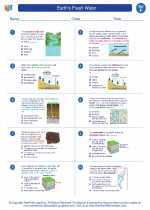 Earth's Fresh Water Worksheet/Answer key
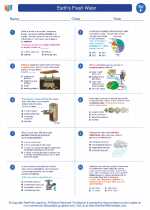 Earth's Fresh Water Vocabulary/Answer key
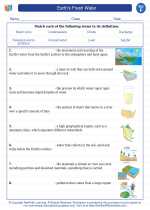 Earth's Fresh Water Vocabulary/Answer key
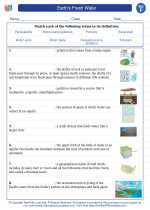 Earth's Fresh Water
Study GuideWorksheet/Answer keyWorksheet/Answer keyWorksheet/Answer keyVocabulary/Answer keyVocabulary/Answer keyThe resources above cover the following skills:
EARTH AND SPACE SCIENCE
Earth and Human Activity
Implement scientific principles to design processes for monitoring and minimizing human impact on the environment (e.g., water usage, including withdrawal of water from streams and aquifers or construction of dams and levees; land usage, including urban development, agriculture, or removal of wetlands; pollution of air, water, and land).