Cnidaria
Cnidaria is a phylum of aquatic invertebrates that includes jellyfish, sea anemones, corals, and hydras. These organisms are known for their specialized stinging cells called cnidocytes, which they use for capturing prey and defense.
Characteristics of Cnidaria
- Radial symmetry: Cnidarians exhibit radial symmetry, meaning their body parts are arranged around a central axis.
- Cnidocytes: These specialized cells contain nematocysts, which are used to inject venom into prey or threats.
- Two body forms: Cnidarians can exist in two main body forms – the polyp form (e.g., sea anemones and corals) and the medusa form (e.g., jellyfish).
- Gastrovascular cavity: Cnidarians have a central digestive cavity with a single opening serving as both the mouth and anus.
Classification of Cnidarians
Cnidarians are classified into four main classes:
- Class Hydrozoa: Includes hydras, hydroids, and Portuguese man-of-war.
- Class Scyphozoa: Comprises true jellyfish.
- Class Anthozoa: Contains sea anemones and corals.
- Class Cubozoa: Includes box jellyfish, known for their cube-shaped medusae.
Ecological Importance
Cnidarians play a crucial role in marine ecosystems. Corals, for instance, form the foundation of coral reef ecosystems, providing habitat for numerous marine species. Additionally, jellyfish serve as both predators and prey in marine food webs.
Study Tips
To effectively study Cnidaria, consider the following tips:
- Understand the anatomy of both polyp and medusa forms.
- Learn about the ecological importance of different cnidarian species.
- Practice identifying and differentiating between the various classes of cnidarians.
- Explore the life cycle and reproductive strategies of cnidarians.
By mastering these concepts, you can gain a comprehensive understanding of the diverse and fascinating phylum Cnidaria.
.◂Science Worksheets and Study Guides Eighth Grade. Volcanoes
Worksheet/Answer key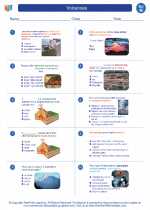 Volcanoes
  Worksheet/Answer key
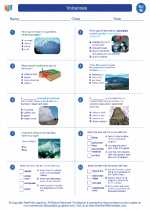 Volcanoes Worksheet/Answer key
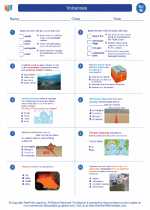 Volcanoes Vocabulary/Answer key
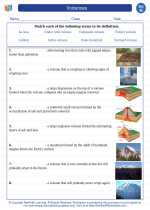 Volcanoes Vocabulary/Answer key
 Volcanoes Vocabulary/Answer key
 Volcanoes
Worksheet/Answer keyWorksheet/Answer keyVocabulary/Answer keyVocabulary/Answer keyVocabulary/Answer keyThe resources above cover the following skills:
Earth/Space Science: Students will use scientific skills and processes to explain the chemical and physical interactions (i.e., natural forces and cycles, transfer of energy) of the environment, Earth, and the universe that occur over time.
Earth History: Explain how sedimentary rock is formed periodically, embedding plant and animal remains and leaving a record of the sequence in which the plants and animals appeared and disappeared.
Explain how sedimentary rock buried deep enough may be reformed by pressure and heat and these reformed rock layers may be forced up again to become land surface and even mountains.