Prefixes
A prefix is a group of letters added before a word to change its meaning. Understanding prefixes can help you figure out the meanings of new words and improve your vocabulary. Here are some common prefixes:
- re-: meaning "again" or "back" (e.g., rewrite, return)
- un-: meaning "not" or "opposite of" (e.g., unhappy, unfair)
- pre-: meaning "before" (e.g., preview, prehistoric)
- dis-: meaning "not" or "opposite of" (e.g., dislike, disappear)
- mis-: meaning "wrong" or "badly" (e.g., misunderstand, misbehave)
Study Guide
Here are some tips for studying prefixes:
- Learn the meanings of common prefixes listed above.
- Practice identifying prefixes in different words.
- Use a dictionary or online resources to look up the meanings of words with prefixes.
- Create flashcards to test your knowledge of prefixes and their meanings.
- Challenge yourself to use words with prefixes in sentences to reinforce your understanding.
[Prefixes] Related Worksheets and Study Guides:
.◂English Language Arts Worksheets and Study Guides Fourth Grade. Vivid Language in Writing
Study Guide Vivid Language in Writing
  Worksheet/Answer key
 Vivid Language in Writing Worksheet/Answer key
 Vivid Language in Writing Worksheet/Answer key
 Vivid Language in Writing Worksheet/Answer key
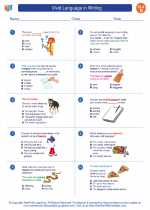 Vivid Language in Writing Worksheet/Answer key
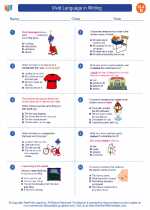 Vivid Language in Writing Worksheet/Answer key
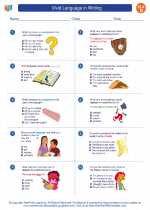 Vivid Language in Writing Worksheet/Answer key
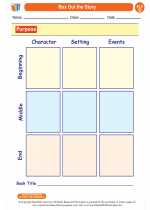 Box Out the Story
Worksheet/Answer keyWorksheet/Answer keyWorksheet/Answer keyWorksheet/Answer keyWorksheet/Answer keyWorksheet/Answer keyWorksheet/Answer keyThe resources above cover the following skills:
Students conduct research on issues and interests by generating ideas and questions, and by posing problems. They gather, evaluate, and synthesize data from a variety of sources (e.g., print and nonprint texts, artifacts, people) to communicate their discoveries in ways that suit their purpose and audience. (NCTE)