Nouns Study Guide
What are Nouns?
A noun is a word that represents a person, place, thing, or idea. Nouns are the basic building blocks of sentences and are essential in forming clear and meaningful communication.
Types of Nouns
There are several types of nouns:
- Common Nouns: These are general names for people, places, or things (e.g., dog, city, book).
- Proper Nouns: These are specific names for people, places, or things and are always capitalized (e.g., John, Paris, The Great Gatsby).
- Abstract Nouns: These are nouns that represent ideas, concepts, or emotions (e.g., love, freedom, happiness).
- Concrete Nouns: These are nouns that can be perceived by the five senses (e.g., tree, chocolate, music).
- Countable Nouns: These are nouns that can be counted (e.g., chair, apple, student).
- Uncountable Nouns: These are nouns that cannot be counted (e.g., water, air, happiness).
Functions of Nouns
Nouns can function in different ways within a sentence:
- Subject: The noun that performs the action in a sentence (e.g., She sings beautifully).
- Direct Object: The noun that receives the action of the verb (e.g., She sings songs).
- Indirect Object: The noun that receives the direct object (e.g., She gives him the book).
- Object of the Preposition: The noun following a preposition (e.g., The cat is under the table).
Practice Exercises
Now that you've learned about nouns, it's time to practice! Try the following exercises:
- Identify the types of nouns in the following sentences:
- The dog barked loudly.
- Paris is known as the City of Light.
- Justice should be served for all.
- We enjoyed the delicious meal.
- Water is essential for life.
- Write three sentences, each with a different function of nouns (subject, direct object, object of the preposition).
Summary
Nouns are fundamental to the structure of sentences, and understanding their types and functions is crucial for effective communication. By mastering nouns, you can enhance your writing and express your ideas with clarity and precision.
[Nouns] Related Worksheets and Study Guides:
.◂English Language Arts Worksheets and Study Guides Seventh Grade. Figurative Language
Study Guide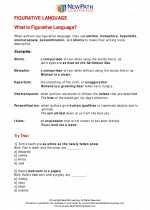 Figurative Language
  Activity Lesson
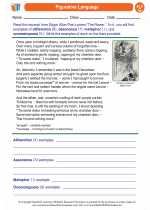 Figurative Language Worksheet/Answer key
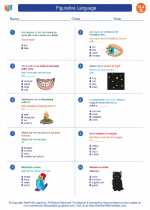 Figurative Language Worksheet/Answer key
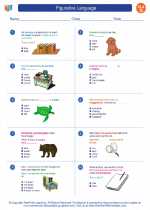 Figurative Language Worksheet/Answer key
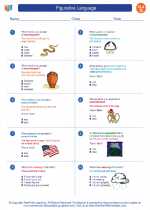 Figurative Language Worksheet/Answer key
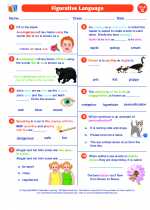 Figurative Language
Activity LessonWorksheet/Answer keyWorksheet/Answer keyWorksheet/Answer keyWorksheet/Answer keyThe resources above cover the following skills:
Students apply knowledge of language structure, language conventions (e.g., spelling and punctuation), media techniques, figurative language, and genre to create, critique, and discuss print and nonprint texts. (NCTE)