Adjective Study Guide
An adjective is a word that modifies or describes a noun or pronoun. It provides more information about the noun or pronoun by giving details about its size, color, shape, age, and other qualities. Adjectives help to make writing more interesting and descriptive by adding depth and detail to the noun or pronoun they modify.
Types of Adjectives
There are several types of adjectives:
- Descriptive Adjectives: These adjectives describe the characteristics of a noun or pronoun. For example, "The green grass swayed in the wind."
- Demonstrative Adjectives: These adjectives indicate specific nouns and include words like "this," "that," "these," and "those." For example, "I prefer this book over that one."
- Quantitative Adjectives: These adjectives describe the quantity or amount of a noun. Examples include "many," "few," "several," and "some." For example, "There are many apples in the basket."
- Proper Adjectives: These adjectives are derived from proper nouns and are capitalized. For example, "We visited the French countryside."
- Interrogative Adjectives: These adjectives are used to ask questions and include words like "which," "what," and "whose." For example, " Which dress should I wear to the party?"
Examples and Exercises
Here are some examples of adjectives in sentences:
- The beautiful sunset painted the sky with vibrant colors.
- She bought a new car.
- We saw an ancient castle during our trip.
Now, let's practice identifying adjectives:
- Choose the adjective in the following sentence: "The red balloon floated in the air."
- Identify the adjective in this sentence: "I need some fresh vegetables for the salad."
- Find the adjective in the sentence: "She wore a sparkling tiara on her head."
Now that you have a better understanding of adjectives, you can use them to add detail and description to your writing!
[Adjective] Related Worksheets and Study Guides:
.◂English Language Arts Worksheets and Study Guides Eighth Grade. Titles and Authors
Study Guide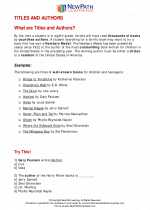 Titles and Authors
  Worksheet/Answer key
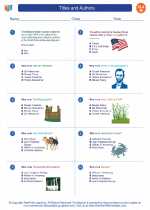 Titles and Authors Worksheet/Answer key
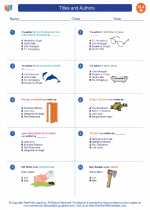 Titles and Authors Worksheet/Answer key
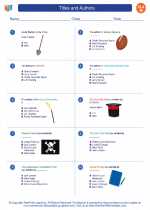 Titles and Authors
Worksheet/Answer keyWorksheet/Answer keyWorksheet/Answer keyThe resources above cover the following skills:
Reading Standards for Information Text
Craft and Structure
Determine an author’s point of view or purpose in a text and analyze how the author acknowledges and responds to conflicting evidence or viewpoints. [RI.8.6]