Subtraction
Subtraction is the mathematical operation of taking away one number from another. It is the opposite of addition and is denoted by the minus sign (-).
How to Subtract Numbers
To subtract numbers, follow these steps:
- Write down the larger number first.
- Write the smaller number below the larger number, aligning the digits by place value.
- Subtract the digits starting from the rightmost column and borrow when necessary.
- If necessary, bring down any remaining digits from the larger number.
Example:
Subtract 357 from 892.
| 8 | 9 | 2 | ||
| - | 3 | 5 | 7 | |
| = | 5 | 6 | 6 |
The result is 535.
Subtraction Facts
Here are some important subtraction facts to remember:
- Subtracting a number from itself results in 0. (e.g., 7 - 7 = 0)
- Subtracting 0 from a number gives the same number. (e.g., 9 - 0 = 9)
- Subtraction is not commutative. The order of the numbers matters. (e.g., 8 - 3 is not the same as 3 - 8)
Practice Problems
Now that you understand the concept of subtraction, try these practice problems to test your skills:
- Subtract 456 from 820.
- Subtract 297 from 500.
- Subtract 84 from 150.
Remember to always double-check your answers and ask for help if you need it!
.◂Math Worksheets and Study Guides Sixth Grade. Mixed Numbers
Study Guide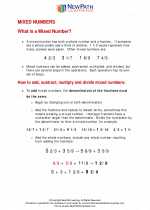 Mixed Numbers
  Worksheet/Answer key
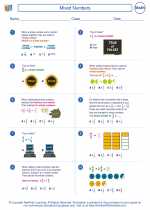 Mixed Numbers Worksheet/Answer key
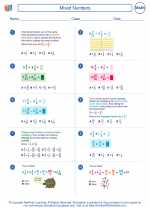 Mixed Numbers Worksheet/Answer key
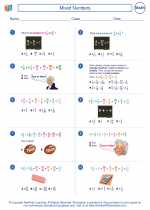 Mixed Numbers Worksheet/Answer key
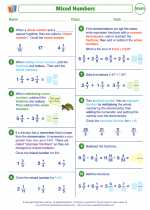 Mixed Numbers
Worksheet/Answer keyWorksheet/Answer keyWorksheet/Answer keyWorksheet/Answer keyThe resources above cover the following skills:
Number and Operations (NCTM)
Compute fluently and make reasonable estimates.
Develop and analyze algorithms for computing with fractions, decimals, and integers and develop fluency in their use.