Line Graphs
A line graph is a type of chart used to show the relationship between two variables. It is particularly useful for displaying data that changes over time. The horizontal axis represents the independent variable (often time), while the vertical axis represents the dependent variable.
Key Components of a Line Graph
- Title: A descriptive title that summarizes the data being presented.
- Axes: The horizontal and vertical lines that represent the independent and dependent variables, respectively.
- Data Points: Individual points representing the value of the dependent variable at specific values of the independent variable.
- Line: A line that connects the data points, showing the trend or pattern in the data.
- Legend: A key that explains the meaning of different lines or colors on the graph, if multiple sets of data are being compared.
Creating a Line Graph
To create a line graph, follow these steps:
- Organize your data into two columns: one for the independent variable (e.g., time) and one for the dependent variable (e.g., temperature).
- Draw the horizontal and vertical axes, labeling them appropriately.
- Plot the data points on the graph, with the independent variable values on the horizontal axis and the dependent variable values on the vertical axis.
- Connect the data points with a line to show the trend or pattern in the data.
- Add a title and legend, if necessary, to make the graph clear and understandable.
Interpreting a Line Graph
When interpreting a line graph, pay attention to the following:
- The direction of the line: Is it increasing, decreasing, or staying constant?
- The steepness of the line: A steeper line indicates a more rapid change in the dependent variable.
- Patterns or trends: Look for patterns such as cycles, trends, or irregularities in the data.
- Comparison: If there are multiple lines on the graph, compare their trends and relationships.
Study Guide
To master line graphs, consider the following study guide:
- Understand the purpose and use of line graphs.
- Practice creating line graphs from given sets of data.
- Interpret existing line graphs to identify trends and patterns.
- Compare and contrast different line graphs to understand how variables are related.
- Use technology (such as graphing software) to create and analyze line graphs.
By mastering line graphs, you will be able to effectively represent and analyze data that changes over time, making it a valuable skill in various fields such as science, economics, and social sciences.
.◂Math Worksheets and Study Guides Seventh Grade. Introduction to Probability
Study Guide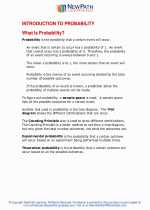 Introduction to Probability
  Worksheet/Answer key
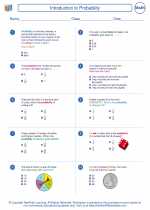 Introduction to Probability Worksheet/Answer key
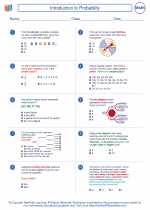 Introduction to Probability Worksheet/Answer key
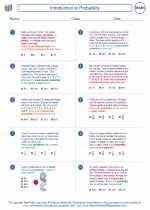 Introduction to Probability Worksheet/Answer key
 Introduction to Probability
Worksheet/Answer keyWorksheet/Answer keyWorksheet/Answer keyWorksheet/Answer keyThe resources above cover the following skills:
Data Analysis and Probability (NCTM)
Understand and apply basic concepts of probability
Use proportionality and a basic understanding of probability to make and test conjectures about the results of experiments and simulations.
Connections to the Grade 7 Focal Points (NCTM)
Probability: Students understand that when all outcomes of an experiment are equally likely, the theoretical probability of an event is the fraction of outcomes in which the event occurs. Students use theoretical probability and proportions to make approximate predictions.